Showing posts with label Have a Drink. Show all posts

Wednesday, March 14, 2007

Anyone for ham and cheese?

Winner for one of my favorite window displays of food in Rome.

Roscioli is an upscale deli where you can also sit down and eat. The prices aren't high-end, but they aren't budget, either. For lunch you'll probably spend anywhere from €20-€30 per person. And mind you, this isn't the place to go for a nice, steaming plate of carbonara. For that, of course, go here, and as an aside, hurry... it just got put in a guide book so all hope of it remaining a secret is lost. No, Roscioli is the place for things like a lovely cheese plate with fruit compote, or a chocolate fondue with strawberries.

It's also an enoteca, or wine shop, so inside you'll see the walls are made up of huge wine cubbyholes that reach to the ceiling. Definitely worth a look.

And, not to be missed, a phrase from their website in typical Italian style:
In the bakery our pizzas follow only risings of more than 12 hours, that make it very digestible because the yeasts have fully developed their activity.
I haven't talked much about this on the blog, but the bold on "digestible" is their emphasis, and Italians can spend HOURS talking about food digestibility. I don't know about you and how things are where you live, but where I come from in the States, I'm 99.9% sure I never had even ONE dinner conversation that revolved around how I digested food.

But hey, maybe that's just me?

Antico Forno Roscioli
Via dei Giubbonari 21 (not far from Campo de' Fiori)
They also have a bakery on Via dei Chiavari 34

Saturday, February 24, 2007

The Limoncello is Brewing...

We finally ended up picking the lemons and now the limoncello is under construction. If you've been to Rome or especially the Amalfi Coast, and you like a little after-dinner digestivo (to help you digest, of course!) then chances are you've tasted the delights of limoncello. It's a lemon-flavored liquor served chilled, and now that we have a couple of little lemon trees, this is the second year we've made some.

It is super easy to make, so if you have lemons around, why not try it?

I call this the "1/2 Limoncello" Recipe

You'll need:

About 10-15 lemons (on the small to medium side)
1/2 kilo (500 g) zucchero (sugar)
1/2 liter acqua (water)
1/2 liter alcool (grain alcohol like Everclear...it has 95% alcohol content, ie 190 proof, no messing around here)
A container to store the limoncello while it's infusing...we're no-frills and are using a metal pasta pot covered with aluminum foil

1) Wash the lemon skins, then peel the skins off with a potato peeler.


2) God only knows what you'll do with the lemons now. You don't need them. You know what they say, when life throws you lemons, make... (sorry, couldn't resist!)

3) Mix the water and alcohol and add the sugar, stirring slowly.

4) Add the lemon peels and cover. Every few days, stir. You can taste it along the way if you want, adding water or sugar if it's too strong. It shouldn't taste super alcoholic, but lemony with a slight alcoholic "bite"--you don't want it too sweet either.

5) Keep this up, stirring briefly every few days or so, for about a month to 40 days. Then, strain the lemon peels and bottle. (Those hermetically-sealed bottles, the ones with the plastic stoppers and rubber rims, will work well, otherwise just use a clean wine bottle and cork it).

5) Chill it and serve in shot glasses. Sip, don't shoot!

Let's say a toast back here in about a month?

Buon weekend and buon limoncello-making!

Tuesday, January 30, 2007

Tea Time at Zeno

[It's Food Week at AHIR: all food, all drink, all week, leading up to World Nutella Day on February 6!]I have a fantastic new discovery for all you tea-lovers out there. Let's just say that finding a really nice cup of tea in Rome isn't the easiest thing to do. After all, we are in the espresso capital of the known world. So, fair enough.

All that is about to change. How is it possible that Zeno has already been open for a year and I hadn't found it? Boh! (Maybe I can manage to use my favorite Italian expression in every post this week.) In any case, now that I've found it, I'm letting you in on the secret.

These people know tea. Not only do you get your very own little tea set when you order, it comes complete with a TIMER that tells you when to pull out the filter. Geniale!

This is the Japanese tea set I got when I ordered the Bancha green tea. Their menu has about 7 pages of different teas: black teas, white teas, green teas, herbal teas, (wait, I'm starting to sound like Forrest Gump with shrimp...I'll stop now.) Besides tea, they also have lots of cose sfiziose, indulgent things, like crepes--I counted no less than 16 different kinds, even one with whiskey and one with fig and pear. The one below was with a 70% cacao dark chocolate and was massively rich. I shared it with my friend but between the both of us we couldn't even finish it.

There are tea smoothies, 8 different types of hot chocolate from Domori, a super-gourmet chocolatier in Genova, as well as hot chocolate "aromatizzato" with flavors ranging from hot pepper to coconut, liquorice, cinnamon and even the intriguing Schezuan pepper. Not sure I'd go there with hot chocolate, but it's fun seeing it on the menu anyways.

This is the tea-prep station where they get your little tea set ready after you order. The wait staff is really friendly and explain everything to you on your first time in. When your timer starts beeping, they give a discreet look over to check on you, just to make sure you know where everything goes and don't need a hand.

The atmosphere is laid-back and trendy without being stuck-up. There is a cozy feeling, like when you curl up on the couch with a good book. I've been here twice and both times I've found it to be a relaxing and enjoyable place to be. I even got the impression that they wouldn't mind if you took a book to read or did some studying, and that, my friends, is really something: it's not easy to find a place to just "hang out," read or study here in Rome. Public libraries are pretty much non-existent, and of those that do exist, most won't even let you bring in your own books! I've found the coffee bars geared to a quick espresso on the run, not kick-back coffee houses like you might find on a college campus, for example. So this is another point in Zeno's favor.

Zeno is in the Prati neighborhood not far from the Vatican Museums, but is so hidden away that no tourists will probably ever discover it, unless it gets listed in a guide book. So, tourists and visitors in the know, take the tip: if you've spent a day wandering around the Vatican and you need to take a load off, let the folks at Zeno pamper you for a bit. You won't regret it!

Zeno
Via Santamaura 60
Open 4 pm-1 am daily; closed Mondays

Saturday, January 20, 2007

Guest Blogger: Eugenio, Wine Expert Extraordinaire (Part Two)

Welcome back to my two-part series on my pal Eugenio (read part one here). Thanks for your comments on part one; it's encouraging to see that I'm not the only one who feels a little unsure about where to start when it comes to knowing about wines. So, without further ado:

Q: You often hear experts talking about smelling things like tobacco, or grass, or other smells… how is it possible to distinguish these smells? Do you need to take a course?

A: It’s true. Wine experts have chosen to tell the story of the scents of wine by using examples of scents that are common to everyone. It’s easier and more understandable when you hear someone say they smell “cinnamon” rather than “aldeide cinnamica,” no? That’s where we get the perfume families that describe the scents: floral (acacia, violet…), fruit (berries, tropical fruit), herbal (hay, mushroom, grass), spice (pepper, liquorice, vanilla), toasted (coffee, cocoa, smoked), ethereal (wax, varnish, caramel), etc.
To identify them it’s enough to just remind yourself of common scents and then look for them in the wine.

Q: Why is it important to smell wine?

A: It’s important in order to appreciate the characteristics typical to a wine and its quality. And then let’s think of the role that scent covers in certain animal species. From bees to dogs, and lastly in humans. Scent gives psychological and physical emotions, and it determines choices. Have you ever eaten something that you hated the smell of? I don’t think so…

Q: You were a judge for the International Wine Challenge, and from what I understand, it’s kind of like the Oscars for wine. How did you become a judge? What was the experience like for you?

In June of 2005 I was at Vinexpo in Bordeaux to choose wines for my Italian and Swiss companies. I was stressing out a poor French producer because I was telling her about the defects I had found in her wine. A woman saw this and came up to me, asking me if I was a sommelier and if I was familiar with the IWC, inviting me to stop by their stand to chat.
I stopped by, got to know the organizers and had a nice chat with them. In the months following we exchanged emails, they evaluated my resumè and then they invited me to participate as a judge in the Challenge. I told them that I was available and I was honored by the offer, which would allow me to taste wines alongside the world’s foremost wine experts, learning from the Senior Judges who I had the pleasure of working with in the beautiful Barbican Center in London.

Behind the scenes at the International Wine Challenge 2006, held at London's Barbican Center

The IWC is the most important wine tasting competition in the world: more than 9,300 wines are tasted and evaluated by 150 judges, only three of which were Italian. Let’s not forget that Italy is the biggest producer of wine in the world. To represent Italy alongside my two “made in Italy” colleagues was an honor for me. Working side by side with these “Masters of Wine” was a completely unexpected goal for me, especially considering that I’m “only” 38.

Q: The whole “scene” that happens at the table when they bring you the bottle of wine you ordered can be intimidating for someone who doesn’t know anything about wine. Tell us then, what is one really supposed to do when the bottle arrives? Are you really supposed to smell the cork?

A: I don’t smell the cork but smell the wine to see if it smells of cork. If this is the case, then I ask them to bring out another bottle. If it’s not the case, then I nod to the server and pour myself a nice glass that I enjoy completely relaxed in good company. It’s fantastic exchanging impressions of wine with my friends. A bottle of special wine can be a gift of invaluable emotions, making an evening unforgettable.

Q: What was or what is the biggest satisfaction you gain from your work?

A: To count among my clients: both colleagues and sommelier restaurant owners, many of whom are the biggest Italian and foreign wine experts in their field; associations dedicated to the promotion of the culture of “drinking well;” not to mention also a few indulgent VIPs famous on a global scale. In Italy you know we have a privacy law, otherwise I would name some names…
This is the payback for all the hard work I do on a daily basis in finding important wines with little prices.

Q: One last question, just for fun: in your opinion, what is “the” wine of 2007?

A: Can I have a back-up question, please? It’s like asking a father which of his children he likes the best. And I have lots of children, at least in an enological sense…
Given that, I’ll close my eyes and respond to you in good faith. I’m betting on Ruchè 2006 from Nadia Verrua. It’s coming out in May 2007 and I think it’s going to make people talk a lot about it. And in tasting it, you’ll understand why…

Thanks, Shelley, for the interview! I wish all your readers a wonderful holiday if they are coming to Italy. And don’t forget that the ancient name of Italy was Enotria, or “Country of Wine.” Surely there’s a reason for this name, no? In vino veritas

Grazie to you, Euge, for the generous information you shared…I had fun picking your brain a bit on a topic that continues to fascinate me. Wishing you all the best in 2007!

If you are interested in contacting Eugenio, you can write to him at: bigliocca AT caveduroi DOT com. Soon he will also be launching a long-awaited website, delayed due to his impossibly heavy workload, at www.caveduroi.com. Keep an eye out for it, and happy wine tasting!

Friday, January 19, 2007

Guest Blogger: Eugenio, Wine Expert Extraordinaire (Part One)

Among my pals here in Italy, I am lucky to count a person who I think has hands-down the coolest and most glamorous job of anyone I know. Eugenio Bigliocca, founder and owner of Cave du Roi, a wine sales and distribution company, is a bona fide international wine expert. And if you think I’m exaggerating because he’s a friend of mine, then I’ll let his resumè speak for itself. Besides the fact that he has been a sommelier certified by the Italian Sommelier’s Association (AIS) since 1994, he is often called on by Slow Food, Italy’s premier foundation for promoting education and appreciation of excellent food and wine, to present and discuss wine; he works with some of Italy’s top up-and-coming “diamond in the rough” wine producers, scouring the Italian countryside personally to discover them and sometimes signing their wines for exclusive distribution; in addition, last year he was asked to become a judge for the International Wine Challenge, a kind of “Oscars” in the international wine community, one of the highest honors that can be bestowed upon someone who works in the field of wine tasting, sales and education.

Since the day I met Eugenio a few years ago, I have been continually impressed by his approach to wine. I’m a total wine amateur—I drink it, but can’t say I know how to properly “appreciate” it. That being said, I’ll admit that I always believed that in order to be a real wine expert, a job pre-requistite was to be a colossal snob. I was not only intimidated by the field of wine appreciation, I was turned off by the idea that you had to have a major superiority complex to be part of this “in” club.

When we first encountered Eugenio after coincidentally sitting next to him at a dinner for a mutual friend, we ended up talking to him literally non-stop for the three hours or so the dinner lasted. I was instantly intrigued and completely enchanted by his down-to-earth approach, and above all his passion for wine, which was tangible and contagious. I took the chance that first evening to ask him lots of “wine for dummies” questions and he never once made me feel ignorant or silly, bringing me instead, even if just for a moment, into that exclusive club I never thought I could join.

For a while when I was contemplating my transition away from my rather overwhelming job as director of a large US university study abroad center, we toyed with the idea of becoming partners in a wine business here in Rome. We talked about opening a wine shop, a wine bar…we let our imaginations run wild. Unfortunately we never took this dream project to fruition; as his business continues to skyrocket and my newborn business of hosting tourists in our apartments picks up the pace slowly but surely, we’ve left our plans aside for the moment. But I can certainly say that if ever there was a perfect person to dream up an incredible business plan with, Euge is the man.

Needless to say, he keeps us in good supply because we get all our wines from him and him alone, including the bottles I leave for my guests in the apartments. It's a little like having a personal wine shopper who knows your tastes and introduces you to amazing wines you weren't aware of, without going broke. So I can definitely admit that in this respect I, and my guests, are quite spoiled!

But enough of my gushing. I’ll let you read for yourself why I think he’s such a rare find in the world of wines. I asked him if he would allow me to “interview” him for my blog, and he was happy to oblige. I’m hoping we’ll all learn a little something new in the process. Grazie, Euge!

Q: How did you start working in the field of wines?

A: Out of passion. When I was five years old I used to help my grandfather bottle wines and… that’s where my mania for “the nectar of Bacchus” started.

Q: What was or what is the biggest obstacle you’ve had to/have to overcome in your work?

A: The incompetence that reigns sovereign over many “experts in the field.” I’m referring to those restaurants and barmen who chose a wine based only on its notoriety or price.

Q: What’s your philosophy on wine? By that I mean: how do you work, who are the producers you work with, what sets you apart from others in your field?

A: I personally choose wines made by “small producers,” almost always unknown to the media. I deal with denominations (denominazioni) of notable origin, made by excellent producers who are often still complete “unknowns.” I love working with someone who makes 30,000 bottles of a quality wine that dreams are made of, rather than 1,000,000 bottles of medium-level quality.

With respect to my competitors, I differentiate myself because by choice, I don’t sell famous brands, but rather “niche” wines. I’ve chosen the path of non-devotion to the celebrated super-famous wines, which are hardly ever truly extraordinary, unless you’re talking about their price.

I try to discover enological jewels and to tell their story to true wine lovers, meaning those who don’t buy wine with a guide in their hand, but who are gifted with critical capability and feeling. And those who trust my judgement, obviously! I like to surprise my clients and ignite their curiosity with my definition of what constitutes a good new wine. My competetive advantage is often better quality at a lower price.

Q: For someone who doesn’t know anything about wine, but would like to start somewhere, what’s your advice?

A: I suggest they sign up for a course held by a qualified professional, for example in Italy I’m referring to something like a course with the Italian Sommelier’s Association or ONAV (National Organization of Wine Tasters). I think it’s impractical to try to teach yourself. I think in this field it’s essential to start off on the right foot.

Q: In your opinion, how can someone tell a “good wine” without being an expert? What are the characteristics that a person should look for?

A: Above all, I would look for an absence of defects. That means I would try to understand if the wine smells excessively like sulfur dioxide. Do you smell a “stink” of burnt rubber or sulfur? Or if it smells excessively like vinegar. Or if it has really strong notes of wood with hints of vanilla. In this last case we’re in the presence of a misuse of the barriques. In the mouth we’re trying to taste if there’s excessive acidity or if it’s well-blended with the alcohols. A wine-tasting course is useful because it teaches you in just a few hours of lessons how to recognize the values and defects of a wine.

Q: Lots of people think a good wine has to be expensive. Is this true, or is it a false myth?

A: False. In a market economy, a wine’s price is determined exclusively by supply and demand. There are incredible wines that cost little only because they aren’t yet in high demand. And these are the wines that I devote my attention to. That being said, I can maintain that I’ve never drunk an expensive wine (by that I mean more than €50 a bottle) of truly low quality, but medium quality, yes.

Q: What then in your opinion is a reasonable price for a “good” wine, or maybe it’s impossible to say because it always depends on something?

A: Often the price is connected directly to the denomination (DOC) of the wine or the region where it was produced. It’s hard to generalize. I would say that in an enoteca (wine shop) I’m willing to spend €12 for vintage wines and €25 for reserve wines, at least as a jumping-off point.

Here's Eugenio and his lovely girlfriend Mariana with Ale and I on the right (like how my shirt matches the tablecloth and curtains?? I totally planned that, you know) during a once-in-a-lifetime vacation we took last summer to St. Petersburg, Russia. He's a total giveaway: look how he's holding the glass, next to us amateurs! Even though he's holding the glass, he was actually the only one who wouldn't brave trying the "chacha," a gut-burningly strong traditional after-dinner drink (or perhaps anytime drink, for that matter) from the country of Georgia. I remember him saying, "You guys are out of your minds! If I don't see the bottle and I don't know where it comes from, there's no way I'm drinking it. You don't understand how risky that can be!" See what happens when your profession causes you to "know too much"? You miss all the fun! ;-) That is, if you consider swigging the taste equivalent of gasoline and rubbing alcohol "fun." Well, like they say, when in St. Petersburg...

The interview continues in my next post, where we talk about what the heck it means when someone says they “smell tobacco” or “smell grass” in wine, and what you’re really supposed to do when they bring that bottle of wine to the table for you to taste. Stay tuned!

Wednesday, January 10, 2007

Everything's Coming Up Lemons

Anyone out there keeping score on my lemon-growing prowess? Back in November I showed you my lemon tree in its quest towards eventual liberation as the Italian after-dinner drink limoncello. That was then.

This is now:

We're getting close, folks! Soon we'll be picking these to make limoncello. Limoncello is a lemon-flavored liqueur sipped in a small shot glass after dinner, typicial of the Campania region (Tracie B., you must be an expert!). Last year we tried making it for the first time and it took us about a month and a half, since it's an infusion so it has to sit to soak up the lemon flavor. Alessandro did it without any recipe (sometimes it seems to me that many Italians are born pre-programmed with a cookbook in their heads) and it came out great, but I found a very detailed recipe in English here, from Deborah Horn at Slow Travel. So, in case you have lemons in your garden or even if not, and you just want to try your hand at this, take a look. Deborah's recipe indicates about 40 days, but there are many recipes and many variations online if you decide to search around. Some take as few as six days, but I suggest you go for the long-haul recipe because the flavor will come out better in the end. It's not difficult to make, just takes a bit of time.

The most important ingredient, obviously, is the lemons. Best if you have a tree that you pick them from so you can use them immediately, but if not, just try to get the freshest lemons possible. One recipe I saw suggested they be used just after they turn yellow, even with some green spots remaining. Sometimes limoncello is made with vanilla and cream and becomes crema di limoncello, a thicker liqueur with a softer flavor.

Have you ever made limoncello or tried it? Do you have a favorite brand or variation?

Thursday, November 09, 2006

The Cofffee with Three F's

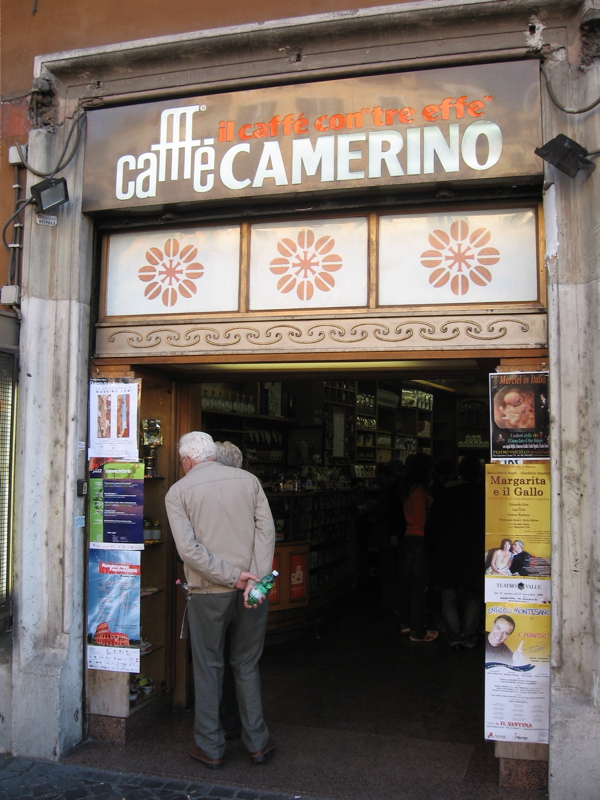
I’d like to introduce you to my new friends Alessandro and Massimo. They, along with the barista magic they perform on every incredible coffee confection in their bar Cafffè Camerino, are the reasons why Italy will probably be the last and only stronghold that Starbucks won’t succeed in infiltrating. How could the Seattle coffee giant possibly compete against smiling faces like this?

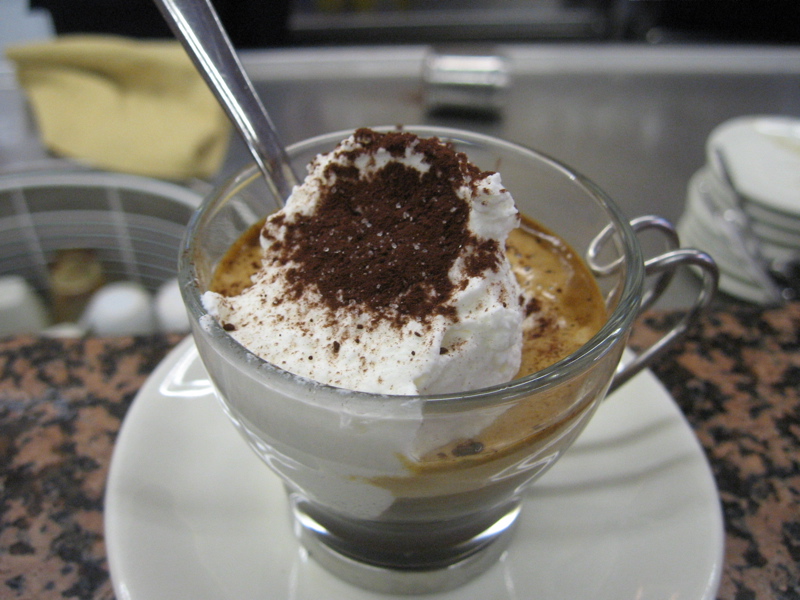
Yes, blogging can be a tough job sometimes, but somebody’s gotta do it. So, I rolled up my sleeves and made the sacrifice for you, dear readers, when I ordered the caffè (cafffè?) completo, a.k.a.: the complete coffee. Oh, and complete it most certainly is. Wanna see?

I can’t take credit for discovering this little slice (drop) of heaven in a cup, made even more heavenly by its price: just 1 euro. No, that honor goes to one of my favorite former students, whose love for Rome drove him to discover the most intriguing hidden gems in the city, among them this. He told me about the caffè completo, and after three years in Rome at the time, I still hadn’t ever heard of it. I've only seen it at this particular bar. It’s like a mini-cappuccino, but better. On the bottom there is, according to Alessandro, “un cremino di cioccolato speciale,” which I think is a chocolate square, and maybe that’s how it starts out in the cup—I’ll never really know because of course it’s one of their trade secrets. By the time it gets to you, it’s a melty chocolate sauce. That’s because they add your espresso on top, along with a dollop of fresh whipped cream and a sprinkling of cacao. Drool.

Maxwell House, you ain’t got nothin’ on Caffè Camerino, because let me tell you that the caffè completo really is good to the last drop. The last desperate spoonful actually, as I scraped the bottom of my cup to capture every bit of that cremino that I possibly could. They took the cup away to prevent me from licking the bottom. That’s just not proper, you see. And since there wasn’t any bread to sop it up, I simply looked on in awe at the remains of what I had just enjoyed.

Now, my blog isn’t exactly The New York Times, even though Massimo told me he got a photo in there too, but my readers are just as special as theirs; Massimo is even going to be looking up my blog so he can print out a copy of my post for Ale, who told me he doesn’t have a computer. Who needs a computer when you’ve got skills like this?

Oh, and in the morning? Don’t miss their delectable cornetto ai ceriali, a whole-grain croissant with warm honey inside. Double drool. Plus, when Christmas rolls around, they are really the best place to get an amazing assortment of panettone and pandoro Italian Christmas cakes (hey, maybe that will merit a return trip).

Folks, when in Rome, do as the Romans do and try "il caffè con tre effe." Why three F’s? I have no idea. Maybe because it’s just so F-ing good! (Oh, come on, I just couldn’t resist…)

Cafffè Camerino
Largo Arenula 30

Friday, September 08, 2006

You say expresso, I say espresso


As my good friend Margaret helpfully pointed out, the debate continues.

Some caffeine to get you ready for the weekend, and a surprise treat at the end.

So, let's begin with one of the first lessons in becoming a real transplanted Roman. Just last week I made a purchase that is essential to all your run-of-the-mill Italian households: the moka. And not just any moka, no siree, we are talking authentic here, so, behold: the Bialetti.

I am now having a flashback of my fianceè Alessandro on our first visit to Phoenix, where I used to live. After bravely trying to survive without his beloved cappuccino or espresso for a total of oh, about 3 days, he surrendered and said that we simply had to find a moka in Phoenix. "You have everything in the United States, so we will find it." After scouring every kitchen store from Chandler to Scottsdale, finally the angels started to sing at Sur La Table, where we spent a pretty penny for the "real thing" and proceeded to make our Italian espresso in the Arizona desert.

So, without further ado, let me initiate you into the sacred world of the vero espresso Italiano.

I’ve created a little photo collage to lead us along. Feel free to refer back as needed.

Now, don't be fooled into thinking that your average-Giovanni Italian has a Starbucks-like set-up at home for his coffee. Oh no, the humble yet elegant Bialetti or some generic knock-off does the job just fine, thank you.

Your choice of coffee is of course all-important. Italians can be coffee snobs. Ask a Roman and you'll probably be told that the best coffee in Rome can be had at Caffè Sant Eustachio, or alternatively at Tazza d’Oro. Today we’ll use a (gasp) supermarket brand from Segafreddo. Storage in hermetic container is a good idea.

Coffee connoisseurs will grind the beans but we are pressed for time, so, note the grind: the moka grind is something between an espresso grind and a drip grind: not too fine, not too coarse. In Italy most pre-ground coffees are produced specially for the moka.

The moka is a simple feat of engineering: just three main parts. There is a tank for water on the bottom, a filter for the coffee in the middle, and a tank for the coffee on the top. Semplice! (Sem-plee-chay)

Now, we can get on with making our espresso. First, fill the small tank with water up to just below the valve. Then, place the filter in and fill it with coffee. Don’t press the coffee down. Then you can screw on the tank, and place it on the burner. A low flame or low heat is best.

Soon your coffee will start bubbling out and you’ll know it’s ready when you start to hear sputtering noises. It usually takes about 5 minutes.

The whole kitchen fills with the coffee aroma: even my cat Betsy wanted some!

Here you have it then: Serve in an espresso cup, about half-full. If you want, you can add milk and then it becomes “espresso macchiato” or “stained espresso."

Wait! Before you go out and buy your very own Bialetti, turn on your computer speakers and check out this great little animated short comparing Italy to the rest of the European Union. Besides the scene of Italians ordering their coffee in a million different ways, you’ll get a preview of some other aspects of Italian life—that we’ll certainly talk about in posts to come!