Showing posts with label See What's Cooking. Show all posts

Friday, February 16, 2007

Roman "Telephone Style" Fried Rice Balls

Otherwise known as Supplì al Telefono. Yes, today's lesson is "How to Make Supplì." Supplì (soo-PLEE) are a traditional Roman appetizer and snack, a fried rice ball stuffed with mozzarella. Why are they often known as "al telefono"? Because legend has it that when you bite into a good supplì, the mozzarella strings out like a telephone line. Personally, that very rarely happens to me, but it's still a creative name, no?

Now, don't confuse the supplì with their southern cousins known as arancini (ah-rahn-CHEE-nee). What's the diff? Roman supplì are fried tomato-flavored rice balls filled with mozzarella, while arancini hail from Sicily and are often a larger, almost pyramid shape, with saffron-flavored rice, meat, mushrooms, and peas.

I'm certainly not the authority on either of these, but here I'll share how we make them in our house. Everyone has their own variations, but ours are pretty simple: rice and mozzarella. No formal recipe here. I'll just show you what we do:

What you’ll need:

Rice
Tomato puree
Mozzarella
2-3 Eggs, beaten
Breadcrumbs
Oil for frying

1. Make the sauce and rice

We use arborio or carnaroli rice—cook it and drain it. At the same time, cook the tomato sauce in another pan using "passata di pomodoro," a tomato concentrate/puree. We don’t do anything fancy for the sauce; we just put some olive oil in the pan, add a bit of onion and sauté it, then add the tomato sauce and let it simmer.

2. Combine sauce and rice

When the rice is cooked, add it to the sauce mixture. You shouldn’t have a soupy texture, you want just enough sauce to coat the rice. Mix it all together and let it cool so that it becomes sticky.

3. Prepare other ingredients: mozzarella, egg mixture, breadcrumbs

Cut the mozzarella into small cubes. Beat the eggs in a bowl. Pour the breadcrumbs into another bowl.

4. Make the rice balls

When the rice has cooled, form small egg-shaped rice balls, making a small indention in the center where you’ll add a bit of mozzarella. In this photo you'll see the rice ball is already covered with breadcrumbs which was a mistake we learned from—too much breadcrumbs means the supplì comes out too dry, so don't be tempted to roll it in breadcrumbs first in order to make it more manageable. If the rice has cooled sufficiently, you shouldn't have problems getting it to form the right shape.

Then cover the mozzarella with some more rice and carefully dip the rice ball in the egg mixture, then carefully roll it in the breadcrumbs.

Really, folks, that’s pretty much all there is to it—all that’s left is to fry them. If you have a fryer you can use that:

If not, you can create your own fryer by filling a large pot with oil and frying them in that. Here's the crispy, golden-brown finished product, which I like to call "Dinner al Supplì":

Ok, I realize that I’m not that good at recipes. The reason is that Ale never uses measurements so I either have to guess or just be generic like I am here. If you want a more professional opinion, check out the recipe from Mario Batali of the Food Network or Kyle Phillips’s from About.com’s Italian Food site. One tip I liked about the About.com recipe is the idea to roll the rice balls in flour before the egg mixture, to keep them from falling apart and help keep your hands from getting too sticky.

Try these out, they really aren't that difficult and make great snacks. We made a bunch of them and froze them so they are ready to pop in the ol' fryer whenever we want. In Rome they cost about 80 euro-cents each and you'll find them at places that sell pizza al taglio (fast-food pizza) or in pizzerie as an appetizer. Buon appetito!

Monday, January 29, 2007

Chronicle of an Abruzzese Dinner

This week, in a grand lead-up to World Nutella Day, I am declaring Food Week over here at AHIR: all food, all drink, all the time. At least this week. (By the way, I do trust that all my fearless readers are getting their entries ready for WND? Don't wait until the last minute! The clock is ticking!)

Allora... we've got to start Food Week with a bang. So where do we turn but Abruzzo? Home of hearty mountain cooking. It's freezing there, people! They have to eat lots and lots so they can stay warm. It's like bears going into hibernation for the winter. Remember when we went hiking (ok, hiking is a big word. Let's say walking.) in the Parco Nazionale? That was to burn off the calories from our previous night's dinner. Abruzzo food=comfort food. Hence the cozy fireplace at Plistia, hidden haven of cucina Abruzzese in Pescasseroli:

And no, you won't go thirsty, just look at that mantel!

The owner here (I think his name is Ciccetto, or at least his nickname is Ciccetto), really went all out. Once he saw the "americana" whip out her camera, he put on a show. I have photographic evidence of all dishes consumed. There's nothing like a crackling fireplace in a rustic Abruzzese restaurant with just a few tables, stuffing yourself with dish after delicious dish, when it's freezing outside. I literally felt like a guest in this guy's home, partly because our friends know him, partly because he's just like that with everyone.

(CUE the boxing round bell....DING! And no, there will be no bikini-clad women holding signs on my blog). Round One:

Most Abruzzo restaurants will first serve you an appetizer of local cheeses and cold cuts on a wooden board. Plistia? Check. These were the cheeses for that evening, slices of which were served to us along with prosciutto and salame.

DING, DING! Round Two:

No, we didn't get the whole thing. It was more for show. But we did get the first piping-hot slices. It was a flaky, phyllo-like pastry crust filled with spinach and cheese. I can't even remember what kind of cheese. I was already nearing food coma.

DING, DING! Round Three:

I'm such a bad blogger. I think I blacked out at this point from food overdose, because I can't even remember what was in this soup. I have a faint recollection of hearing "cotechino," which is a pork sausage traditional around the New Year (we were there in early January), but folks, shame on me. You'll just have to guess from the shapes floating in the bowl. Gnocchi? Potatoes? Boh! (All-purpose Italian word for "who knows!")

I'm about to throw in the towel, but no! DING, DING! Round Four:

Now, these ravioli I definitely remember. They were something special. Red turnip ravioli filled with ricotta and walnuts. Speechless. Ravioli with ricotta and walnuts in general are heavenly, with just a touch of olive oil and fresh parmesan.

And just like Rocky, we push onwards. Yo, Adrian! DING, DING! Round Five:

At this point you'll just have to start describing the dishes yourselves... running out of steam... must keep going... there was some green stuff... and some grated cheese on top...

DING-DING! Round Six: (Attention vegetarians: Hide your eyes! Look away! Look away!)

As if we needed a nice, juicy steak on top of everything else. And folks, please note that this was not a communal steak but just my personal plate (or personal huge wooden board, if you will). Often in Italy I've found that meat is served "al sangue" which is rare, to bring out the flavor. You'll never find a menu here like the one I once saw in the States, basically telling you that if you ordered anything less than medium you were at your own risk, the State Health Department didn't recommend it, etc... no, here most of the restaurant owners either butcher their own meat or know the butcher and get it fresh, so it's less of a worry.

Oh, people, the end is near! When our friend called in the afternoon to make a reservation, the owner asked us if we wanted crema pasticciera for dessert. This was freshly homemade that day, warm confectioner's custard oozing out from crispy, sweet millefoglie wafers and powdered sugar. Can you say YUM? Yes, there was still room left for this. How can you resist?

And Ginkers, this was the photo I was talking about, just for you. The owner pulled out a box of his "special" grappa, this one from Nannoni, an unopened bottle, pointing out to us that the license number was 000001 or something like that, meaning that these were the first producers to ever acquire the license the government put into place for grappa producers. Ginkers, you could probably explain it better, but after all, it's the drinking of it that counts, as I'm sure you'd agree? Ale and I were actually the only ones brave enough to try. Me likey.

With this, our Abruzzese food battle is over. We've lost; we were really no match for these dishes in the first place, but we leave contented anyways. I don't know if I'll ever get back to Plistia, but if you ever go to Pescasseroli sometime, I highly recommend it. And ask Ciccetto what that green stuff was, will you?

Ristorante Plistia
Viale Principe di Napoli 28
Pescasseroli, Abruzzo
Tel. (0863) 910732

Thursday, January 18, 2007

Waiter for a Day

I have so much good stuff backing up in the post pipeline that I think I'll take the day off to sort it all out. I haven't even shared my colossal dinner in Pescasseroli with you, and that alone will take a while, sorting out all the photos of each dish! Get your appetites ready.

Meanwhile, how's this for efficiency? Here's the only restaurant in Rome where I've seen something like this. It's called Pizzeria San Marino and is a bit out of the way from the center--if you know Rome at all, it's over in the Corso Trieste area off of Piazza Istria (north Rome). When you arrive, you find this list with a pen on your green checkered tablecloth:

That's right, folks. DIY ordering. Just browse the list, put the number you want of each item next to it, and when your waiter comes by you hand him the list.

Just make sure everyone at your table is in agreement. Ale went first and put "4" next to supplì (pronounced "soo-PLEE", a fried rice ball filled with mozzarella...worthy of its own post) and there were four of us, without even asking if anyone else wanted one. So as the list made its way around the table, there was a lot of: "FOUR supplì? I don't want a supplì, I want a bruschetta!" I guess he figures that a supplì is a necessary part of any healthy pizza-balanced diet, and in Rome, I guess he would be right!

Pizzeria San Marino
Via S. Marino 52
Tel. 06 85 58 439
(Closed Sundays)

Friday, January 12, 2007

Rome Sweet Rome

Something I'll never get tired of here in Rome is the delight in buying something as simple as a cake or some cookies. When you go to a bakery, they take your order and then place everything on a golden tray, wrap it in special paper and tie it with ribbon. You walk out every time as if it were your own birthday and not someone else's and it's just one of those little fun things that makes living in Rome special for me.

Today's post isn't about an Italian bakery, however. It's about a Austrian bakery with Viennese specialities in Rome. La Dolceroma is located in the Jewish Ghetto just across from Tiber Island. Yesterday after doing some shopping in a nearby store I had an urge to stop in to this bakery.

I knew what I was getting myself into. This place is like a cake boutique: it ain't cheap, folks. Ale's favorite dessert is the Sachertorte (sounds a little like "soccer tort"), a cake from Vienna that was invented by Franz Sacher in 1832. It has two layers of a kind of dry chocolate cake, with apricot jam in between the layers, and covered in a chocolate shell or thick dark chocolate fudge icing. "Das Original" is sold at the Hotel Sacher in Vienna, which was opened by Franz's son in 1872.

But I digress. Finding Sachertorte in Rome isn't difficult, but finding one that is close to the real thing can be a challenge. La Dolceroma has it, but you'll pay a pretty penny: €4 per slice (about $5.20). Actually now that I think about it, I paid $5.20 for a small (ahem, I guess that's technically known as a "tall") Starbucks something or other when I was in the States, but I confess I almost felt ashamed. I don't consider myself to be a crazy penny pincher, but that seemed like a lot. Anyhoo, back to our story, point being: La Dolceroma can be fun for a splurge once in a while.

Sachertorte and Imperialtorte

Besides the famous Sacher, they have some American goodies that Italian bakeries don't sell, like blueberry muffins, brownies, carrot cake and chocolate chip cookies (€1.80 each!). They have lots of other cakes as well. I got the "Imperialtorte" that you see on the right above, and it was some kind of concoction of marzipan and almond cream--very good. Sold by weight though, another thing I didn't realize 'til the girl rang up my order--a little over €5 for the square piece you see above. The Imperial Torte is pretty heavy and costs €3.50 per 100 grams (about 1/4 lb.).

Playing around with the macro function on my camera, allow me to bring you up close and personal with these cakes:

H.R.H. Imperial Torte

Sacher Torte

La Dolceroma is worth a visit if you're wandering the Jewish Ghetto area. You could stop in for a cookie or a truffle. It's next-door to the Portico d'Ottavia, which is an interesting monument.


La Dolceroma Austrian Bakery
Via del Portico d'Ottavia 20/B
Tel. 06/6892196

Tuesday, December 12, 2006

First Stop on the Gelato Tour

Is everyone here? You, in the back, can you hear me? Ok, just follow me…see this red flag I’m holding, if you don’t see me, just look for that red flag. Right this way!

The Gelato Tour doesn’t have a long and storied history, but as time goes on I have no doubt it will. Sara, aka Ms. Adventures in Italy, is our fearless leader, and you can go on other tours here. I am one of your trusty tour guides for Rome, and while our first stop today isn’t necessarily my absolute favorite gelato place (there are so many and my true favorite isn’t that close to my house, so we’ll have to go there another day), it is definitely the winner in my book for sheer number of choices. I give you: Della Palma, just steps from the Pantheon, an area where there's quite a bit of competition for your gelato money. So it's a good thing you have a tour guide to help you wade through the Roman gelato jungle.

I took four shots of the glass cases of gelato here, and I still hadn’t covered all of them. It’s usually full of tourists, but I managed to stop by when there was hardly anyone, which was perfect for getting all my photographic evidence.


By the fourth or fifth shot though, the guy serving gelato was so amused that I decided I better order something.

I got the smallest cone, giving me a choice of two flavors, so I picked biscotto and Galak (a white chocolate named after a candy bar here). The biscotto tasted like cookies and cream, which I loved, because it isn’t that easy to find. The best thing about Della Palma is that if you have a favorite gelato flavor and you can hardly ever find it, chances are good that it’s here. I didn’t ask how many flavors they have or count, although a list on Fodor’s says one hundred (seems a strangely round number, but it’s probably pretty close).

One of the only drawbacks to this place is the fact that it’s a little pricey. I didn't write down the prices, but I think I paid €2.50 for a small cone, which is about 1 euro more than what I'm used to. Most of the places around the Pantheon are higher, because they obviously cater to tourists.

While we’re on the topic, be sure to look at the price list before ordering at shops in these touristy areas, and if there isn’t a price list displayed (although that’s technically against the law), be sure to ask how much a small cone, or a cone with the number of flavors you want, costs. Once one of my study abroad students told me that she was charged €5 for a small cone, and was only told the price after it was being held out to her, dripping. It’s a bit uncomfortable at that point to start arguing that you’re being ripped off. However, if that had happened to me, I would have told the guy thanks anyways and let him eat the gelato. As I always say, don’t be afraid to refuse things if you feel you’re being ripped off. A small gelato (meaning 2-3 flavors depending on the shop) should run you anywhere from €1.50 to €2.50. Even if its higher, it's OK so long as you know that's the price before you order. Pay first, or at least ask, then order.

In addition to “regular” gelato, Della Palma offers variations on the theme, like mousse in several flavors (though only available in a cup, not a cone, because it doesn't have the same consistency as gelato). It’s also a candy store, so could be a good place to pick up some goodies for friends and family, or just for yourself.

Something I love about Italian gelato shops is how they randomly place objects representing the flavor in the middle of the tub. I used to wonder: ooooh, who's the lucky duck that gets that in their cone? Just imagine if this landed in the middle of your cone of cappuccino flavor gelato:

Hey, check me out, I'm going to try to be all artistic-like and take a shot of my half-eaten gelato in its natural environment of the Pantheon:

And I’m not the only one who likes this place.

As we wind up today’s visit, I’d like to have you take a look at Fodor’s list of the best gelato in Rome. First, I can assure you that my favorite gelato place is not on the list, and that’s because it’s not touristy. And I can also assure you that, in my highly unbiased opinion, it truly is THE best gelato in Rome. In a future visit I will be happy to take you there—it’s in a big neighborhood and not that hard to reach with public transport. Meanwhile, feel free browse the others on the list and try to guess which, if any, I’ll pick for future stops.

Della Palma
Via della Maddalena 20/23 (near the Pantheon)
Tel: 06/68806752

Friday, November 24, 2006

Da Enzo: Down-home Roman cooking

Well folks, it’s Friday, and I’m feeling generous, so…while many of you figure out what to do with all that leftover turkey, I’m going to share another secret of cucina Romana (Roman cuisine) with you.

I’m letting you in on a place that I consider one of the last great strongholds of true Roman cooking in the city. It’s not just my opinion, but the opinion of many of my Roman friends as well. This is a place where you can get very authentic Roman cooking but not spend a fortune, definitely a rarity.

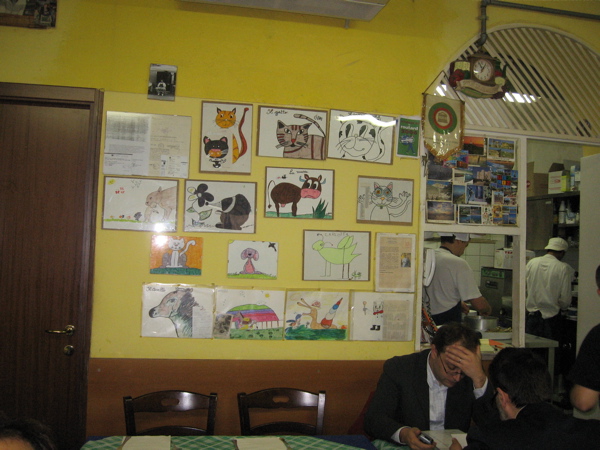
I give you: Da Enzo, right around the corner from my apartments here in Trastevere. This photo shows the wall where the owner has hung a bunch of drawings by his daughter, and the kitchen on the right.

This place is literally a hole in the wall: I think there are about 10 tables inside. Hence, if you don’t make reservations, you’re probably not getting in. For dinner they run two turni—one at 8 pm and one at 10 pm. Service is usually quick, no-nonsense, efficient and the whole ambience is simply down home.

Hungry people waiting outside Da Enzo for the 2nd dinner seating

I’ll let you in on another little secret: as an appetizer (antipasto) you simply must order the carciofi alla giudia.

My carciofo before I savagely attacked the poor thing

These are “Jewish style” fried artichokes (in ancient Rome, the majority of the neighborhood inhabitants were Jewish) and are a typical Roman dish that is becoming harder and harder to find these days. Lots of people will tell you to go to the Jewish Ghetto neighborhood to try them, at places like the overrated and overpriced Da Giggetto, but Da Enzo has them just as good and you’ll spend half the price for your meal, in a decidedly non-touristy environment.

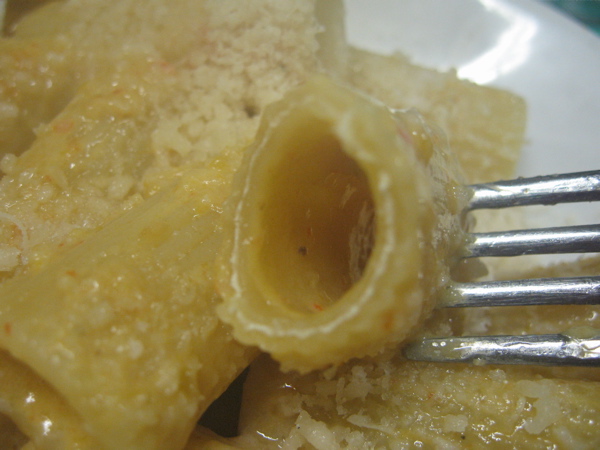
For your pasta dishes, Enzo has a good selection of the basic Roman classics, like arrabbiata, amatriciana, and carbonara. I think one of their great selling points is that they know exactly how to cook pasta al dente, that Italian style of cooking the pasta so that it is firm to the bite.

See how there’s a white ring in the middle of the pasta when you bite it? That’s the part that remains uncooked and gives it that special al dente consistency that is the mark of a great Italian pasta dish. After getting used to this style of cooking pasta, it can be hard to go back to the squishier version we have in restaurants in the States, which Italians call scotta, overcooked.

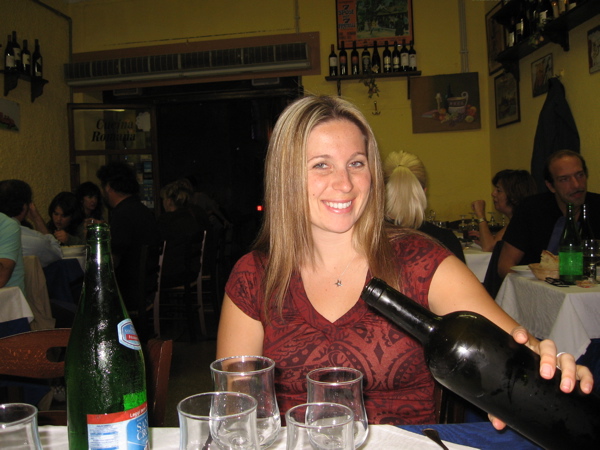
Whenever we have visitors, this is one of the places we always try to take them. As the smile (and big bottle 'o house wine) will tell you, our most recent visitor and favorite houseguest Jessica definitely approved!

Da Enzo
Via dei Vascellari 29 (Trastevere)
Tel. 06 581 83 55
Open for lunch and dinner, closed Sunday
Reservations highly recommended
Average cost for dinner: approx. €25-€30 per person (appetizer, pasta, dessert, house wine)

Wednesday, November 22, 2006

Cookie Swap 2006: Ugly But Good


I found the cookie swap through my bloggy buddies Abe and Hap (they're pugs, check them out!) who play the Saturday Photo Scavenger Hunt. I loved the idea, organized beautifully over at My Smoky Mountain Homeschool.

So, here goes, folks: I submit for your consideration an Italian recipe for cookies known as Brutti Ma Buoni: Ugly But Good.

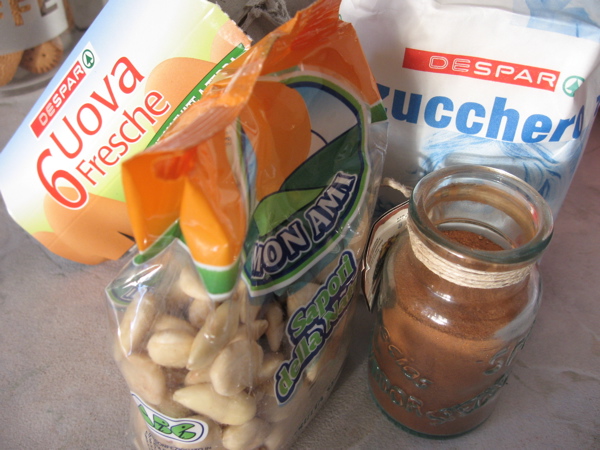
I've bought these cookies in bakeries here and the cookie swap was a perfect opportunity to try to recreate them in my own kitchen. I looked in a cookbook we have here at home (L'Enciclopedia della Cucina Italiana, no less) and found the recipe, and was surprised to see just 4 ingredients:

500 grams toasted almonds
300 grams sugar
5 egg whites
pinch of cinnamon

What? No flour? No milk? Not even water? I was intrigued.

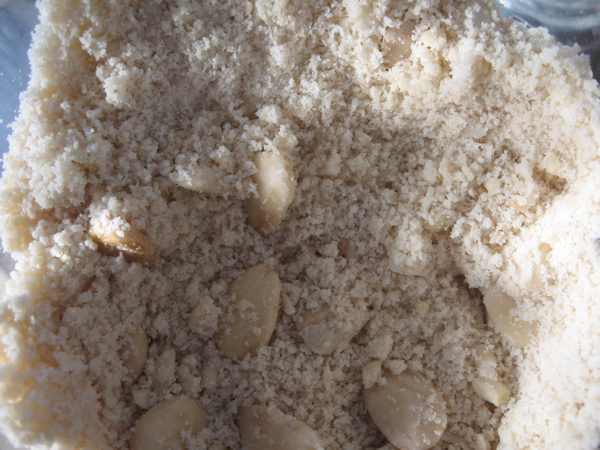
1. Ground the almonds with a little sugar. (PS I don't think the almonds I bought were toasted, and they worked just fine.) I used a blender for this operation b/c I don't have a food processor. It worked fairly well, and the almonds turned into the fluffy concoction you see below. Hmmm, almost like flour...maybe I'm starting to understand.

2. Beat the egg whites until white and fluffy. (In Italian they call it a neve, like snow.) Add the sugar, then add the egg white mixture to the almonds, and add a pinch of cinnamon. Mix.

3. Pour the mixture into a large pan and cook over a very low flame, stirring constantly, until the mixture doesn't stick to the edges of the pan. (Frankly, I'm not sure how long you're supposed to do this for. I did it for like 15 minutes and I'm still not sure if the mixture wasn't sticking, but, it came out a little thicker.)

4. Let the mixture rest for a few minutes. Scoop spoonfuls (about 2 small teaspoons each) of the batter onto a greased baking sheet, about 1 inch apart.

5. Bake in a 150°C/300°F pre-heated oven for 25-30 minutes or until golden brown. Cool on a baking rack, then serve. Makes about 2 1/2 dozen.

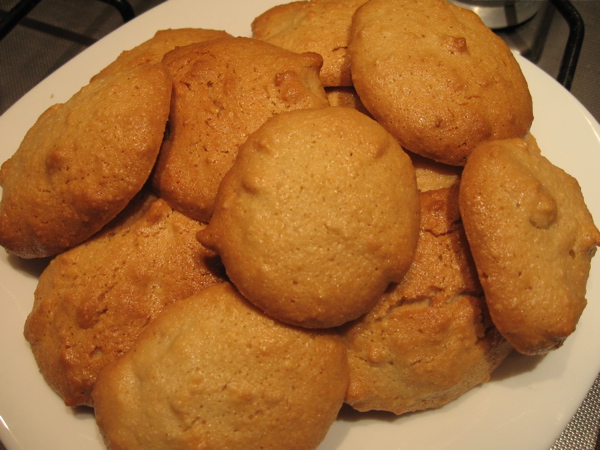
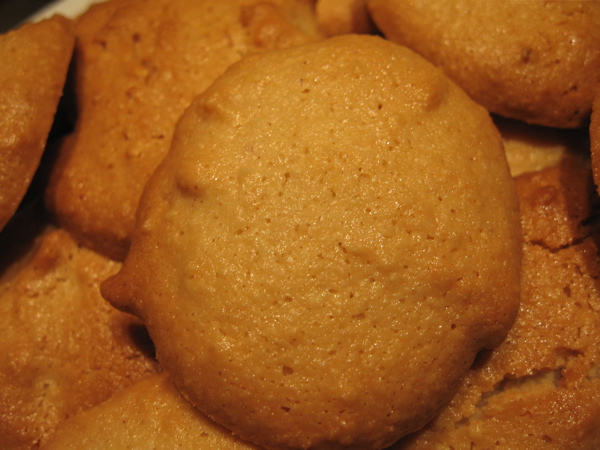
Here's the final product:


They're not that ugly, are they? I am most happy to report that these came out even better than the ones I've tasted from the bakeries. I'm convinced it's because they are fresh. I think they keep pretty well and so I suspect the ones in the bakeries aren't always necessarily from that day. I was surprised at how soft and light they were--I thought with such a heavy almond paste, they wouldn't come out like that.

As part of the cookie swap, Smoky Mountain asks us to tell the "story" behind these cookies. I've kind of told it along the way. It wasn't passed down to me from anyone. I simply really like these cookies and I'm glad the cookie swap gave me the push to try them at home. I'm really happy with the results. And I'm also happy to break the myth that the only Italian cookies that exist are what we Americans know as biscotti (which in Italian simply means "cookies"), which here in Italy are often called cantucci and not dunked in coffee but rather in a sweet wine called Vin Santo.

Speaking of wine, leave it to an Italian cookbook to recommend what wine to drink with your cookies. Mine says that Brutti Ma Buoni go good with a dry, sparkling white, and suggests Prosecco di Conegliano. (Maybe you can stop by my buddy Brendan's Roman Wine Company and pick up a bottle! Or his new, revamped blog, where you'll learn all about Italian food and wine. One of his latest posts was a trip to an olive oil factory.)

If you love candy bars like PayDay or peanut brittle, I think you'll like these cookies. Even though it's almonds, not peanuts, they have that same sweet, nutty taste.

Let me know if you make a batch. I'd be curious to hear how they turn out and what you think!

Happy Holidays!

Tuesday, November 21, 2006

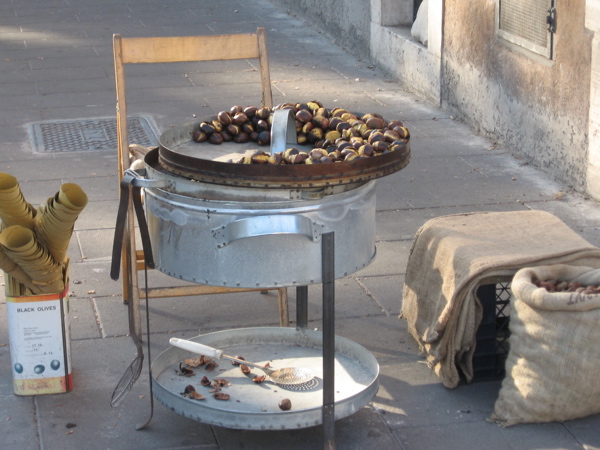
Castagne Roasting on an Open Street

Chesnuts roasting on an open fire—well, growing up in Washington state and then living in the desert of Arizona for nearly 10 years—I never saw them. Not until I came to Rome.

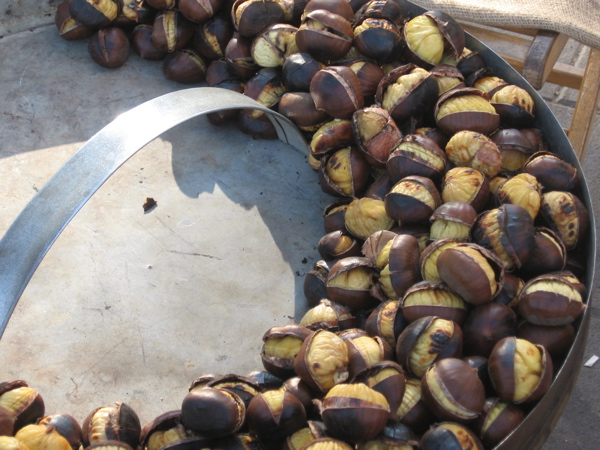
Granted, this isn’t exactly what you’d call an “open fire,” but, it’s about as close as you can get on the Rome streets this time of year.

Chestnuts, castagne (cah-STA-nyay) start to appear once the weather turns chilly, and it’s another thing I love about fall in Rome.

Mind you, this little sidewalk snack can get a little pricey. A couple weeks ago when I asked first, above all, (word to the wise), how much they cost, and I got the response €5, I told the man, “No thanks, that’s too much.” He said, “How about €3?” and just like that, we had a deal. Don’t be shy when you think it just doesn’t seem right. As we say here in Rome, “ci provano,” which means, “they try,” or simply, if people are willing to pay, they’ll keep asking, until someone comes along and challenges them on it. His stand didn't have any prices written, but most do.

They put the chestnuts in a little paper cone and you can walk around with them. There’s usually about 5-10 in the cup.

I finally did get to roast chestnuts over an open fire my first Christmas here in Italy, in a tiny little town called Arcinazzo Romano, and we ate them while enjoying a bottle of Cesanese del Piglio Dolce, a sweet (dolce) red wine (Cesanese) that comes from the nearby town of Piglio.

What autumn traditions start to appear this time of year where you live?

Sunday, November 12, 2006

They're Baaaaaaack....

Every year about this time, something strange happens. Mutant Nutella jars, most likely hatched from special pods in one of the Ferrero factories, start appearing in big displays on grocery store floors.

Wait, let me back up a moment. Are we all aware of the Italian phenomenon known as Nutella? I'd go so far as to say that it is as much a part of the Italian culture as pasta and caffè. I always think of it as the Italian version of peanut butter. It's a chocolate-hazelnut spread that most commonly goes on bread, or—let's not be shy with the truth around here—eaten straight from the jar. It's famous on crepes and is eaten for breakfast on crunchy pieces of melba toast. You've gotta love a country where a rich concoction similar to super-fudge chocolate icing is an honest-to-goodness breakfast food.

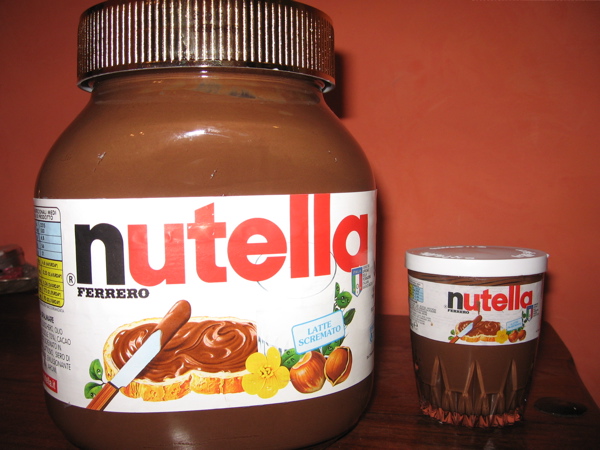
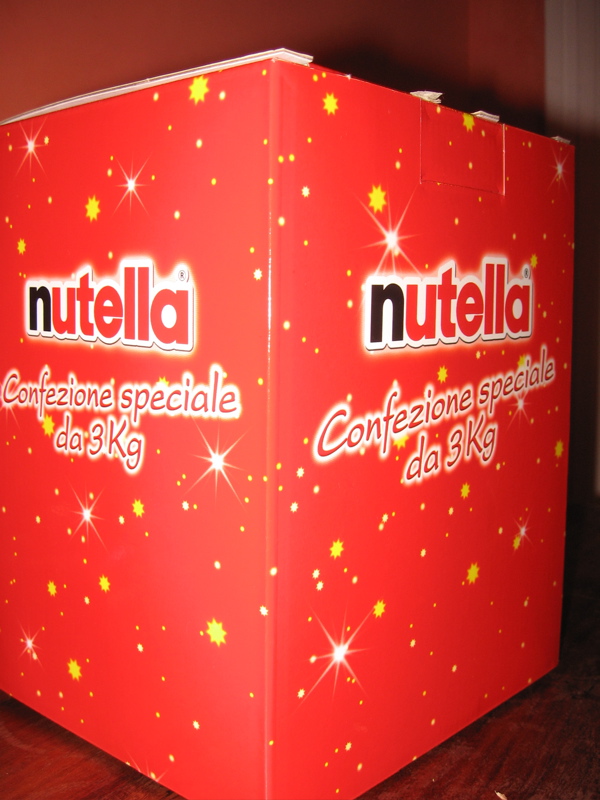
But, back to the main story. The Nutella I normally buy comes in a 200g (about 7 oz.) jar, and when it's gone you can rinse out the jar and reuse it as a juice glass. Visualize: juice glass. The mutants that come out for the holidays have been injected with something at the factory, because they are no less than 3 kilos in weight. THREE KILOS, people. That is 6.61 pounds of pure, vegetable oil-laden goodness.

Note how, in typical McDonald's take-out bag style, I have carefully arranged my humble 200g jar next to its mutant cousin, to give you an idea of what we are dealing with here.

Now, I love Nutella as much as the next guy, but not as much as my pal Jessica, a.k.a. Finny Knits. While I'm sure many a blog post has been written singing the praises of the stuff originally known as "Supercrema," the most recent one I know of is hers. Finny was out visiting in October and little did I know that she has a thing for Nutella. A little side fling, unbeknownst to her poor, unsuspecting hubby. Given that this girl is one of the few people I consider more than a best friend, but like a sister, I did something this year that I've never done before: I bought the 3 kilo tub-o-'tella. And come hell or high water, that puppy is making it across the Atlantic this holiday season. "Friendship is..." when a 3 kilo box of Nutella becomes a carry-on. Yes indeedy, 'cuz it most helpfully comes with its very own box!

The only drawback is the lack of wheels for when I'm running through the airport. Luckily I don't have any stops in London, so it should make it on OK (since I highly doubt they'd let that go in the little transparent bag for ChapStick and keys). I just hope they don't make me eat some to prove it isn't lethal. I'm sure Finny wouldn't appreciate that.

Sunday, November 05, 2006

Do You Knead?

Even to this day in some of the most traditional Italian homes, when a son wants to marry a girl, the future mother-in-law will ask the prospective bride something along the lines of “Ammassi?” Now, maybe that isn’t the exact word they use, but it’s the verb I’ve heard in Rome to describe the act of kneading dough, or rather, making pasta all’uovo (egg pasta), also known as pasta fatta in casa (homemade). I’m not making this up: I myself know of one Italian girl in her late twenties who just got engaged and whose mother-in-law asked her this very question. (The answer of course, was an enthusiastic sì! Let's not kid around with things this serious.)

Luckily, my Roman mother-in-law is about as hip and modern as they come, and this question never passed her lips. She accepted her nuora americana with open arms and hasn’t ever pushed me to be anyone or anything I’m not. But, maybe there’s something to be said for homemade pasta in the family blood, because my future hubby, the undisputed chef of the house, has been mentioning lately how much he wants to try his hand at pasta all’uovo.

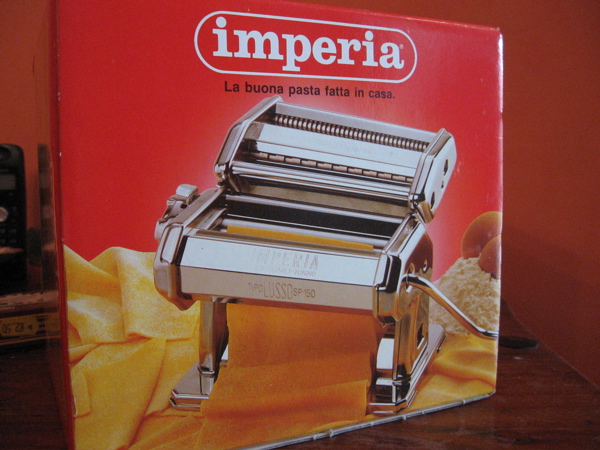
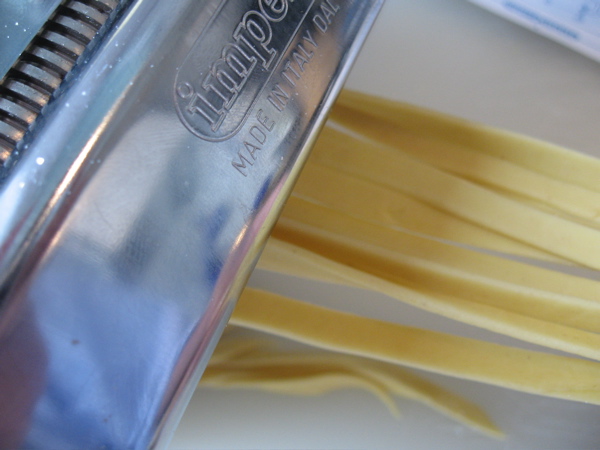
Since today is said future spouse’s birthday, it was the perfect occasion to bestow him with—behold—(cue the trumpets): the Imperia.

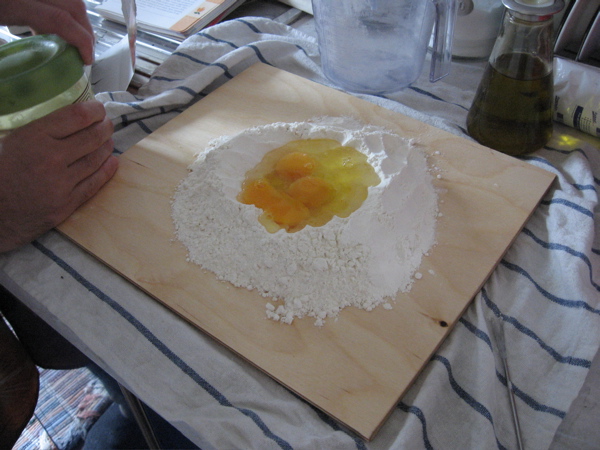
Ain’t she a beaut? Ale was so thrilled with his gift that he insisted we try it out for lunch today. I’m not kidding you folks, this was literally like the Italian grown-up version of the Play-Doh Fun Factory. You start with a little mound of flour and crack some eggs into it, like so:

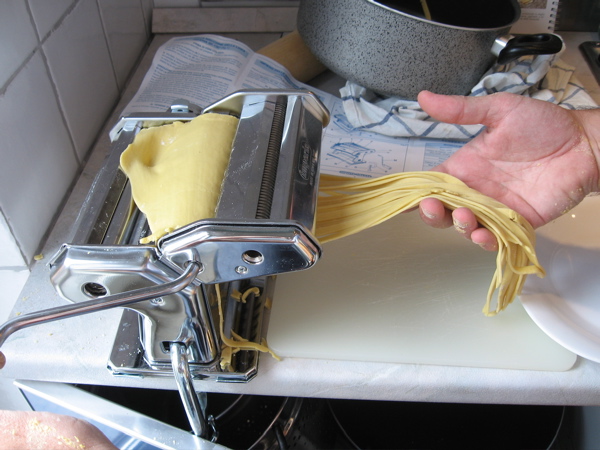
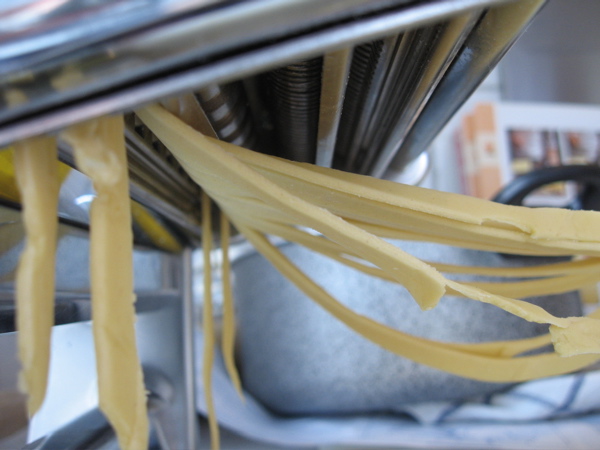
Then you just dig in and start mixing it all up with your hands. After an incident with a bit of a rebellious runaway egg, Ale got the dough together. And despite some first-time trial and error, adding a little more oil here, a little more flour there, and a whole lot of “ammassar-ing”, whaddya know? The little thing works!


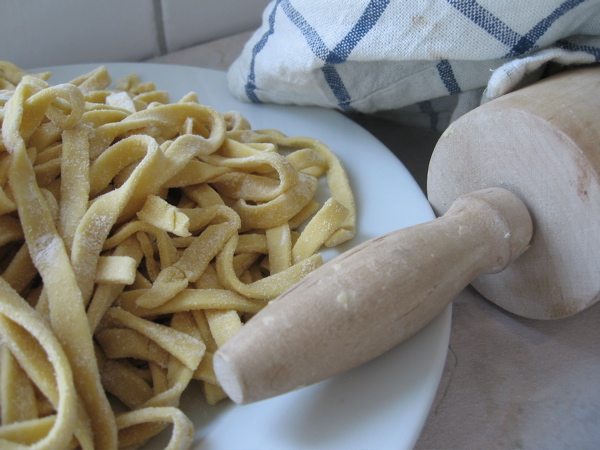
It is a bit time consuming but there’s a special satisfaction in enjoying pasta you’ve made yourself. It only takes about 5-7 minutes to cook once you finish. All told, for our first time out, I think it took us less than an hour, and next time it will probably take about a half hour. I even bought some cutters for making ravioli (pumpkin ravioli, anyone? Mmmm….)

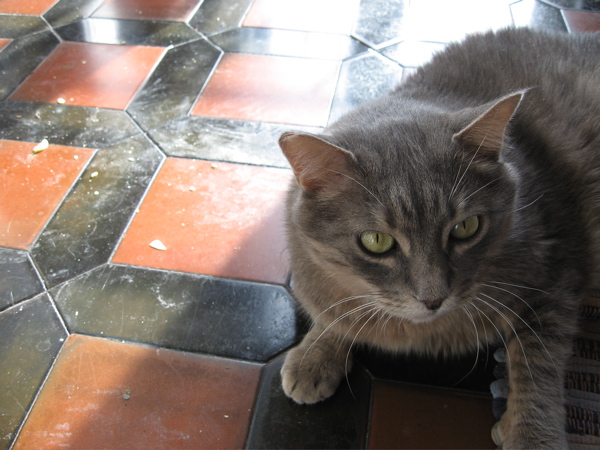
And of course, I can’t leave you without the token "utter kitchen destruction/king of the house a.k.a. Pavel the Cow Cat" photo:

Today’s extra-special destruction involved a full vacuuming and mopping of the kitchen floor! What a treat!

So, if you’ve ever had an itch to make pasta from scratch, I can testify that not only is it fun, but incredibly delicious. Have any of you ever tried this before? What’s your favorite type of pasta?

Friday, November 03, 2006

What a Roman Eats on a Diet

There's a dieter in my house. After a month of living on a movie set (eating every day at an amazing seafood restaurant on the bay run by a man named Pasquale, who offered Ale whatever he wanted to eat in the hopes of getting his restaurant into a scene in the movie, a tactic which eventually worked), and then going on holiday for nearly 2 weeks, my other 1/2 came back feeling like my other 3/4. Just a few kilos to lose, but it's serious this time. My Wedding Channel planner anxiously announced at my last log in: 144 days to go!! That means, 144 days until permanent photos record our day for all of posterity. That's motivation enough for anyone.

So, Ale has decided to burn off those few extra kilos and he's the chef in our house, meaning I'm sort of on a diet too. Not that I mind. Because dieting Roman-style isn't so bad.

Like most Italians I know, Ale doesn't use recipes when he cooks, or measuring cups and spoons for that matter. He just eyeballs the ingredients, uses his creativity, and adds salt to taste.

Rome temperatures right now? Big-time BRRR. And everyone keeps posting pictures of pumpkins on their blogs. While I'm not as brave as Ms. Adventures in Italy, buying an entire monster squash to then craft it singlehandedly into culinary perfection, I do have a tactic. I buy things, stick them in the refrigerator, and wait for Ale to invent something wonderful. Which is why I bought the package of pre-cut pumpkin the other day and stuck it in the fridge, waiting patiently. Then, last night:

Pumpkin risotto! My pictures aren't stunning; I don't have a super camera like some of you fancy-shmancys out there (I'm not jealous, no...), but I did my best. I wish my blog had scratch and sniff because the aroma of this cooking is just heavenly.
Here's the finished product:


It was as delicious, as always. The only trade-off in having a chef in the house is this:

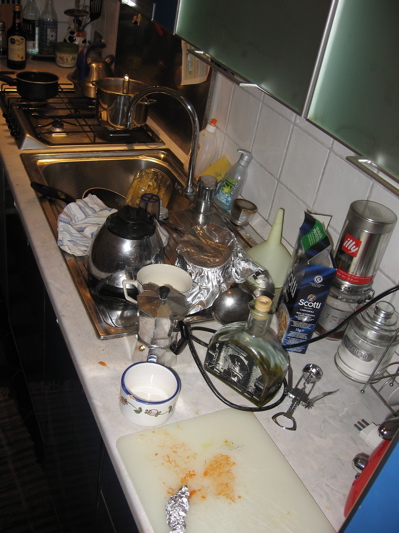
An artist can't be constrained by the limits of cleanliness. Therefore, on a regular basis I face the utter destruction of our tiny kitchen. Finny's hubby can vouch for this, as he has my role in their house being that she's the master chef (even though Bubba can cook up some mean BBQ), and after his cleaning debacle, I think that's the last time he's ever letting this Roman loose in his kitchen.

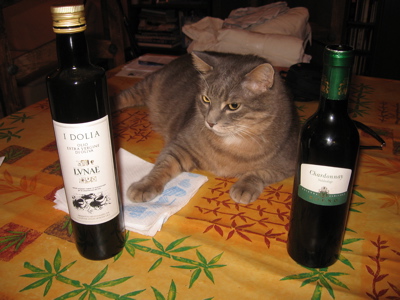
And of course, just to make sure we don't forget who's really in charge around here:

Now, I promise, this won't hurt a bit. Takes about 20 minutes and even I can make it, which is a guarantee of something easy yet delicious. Getting exact amounts for this was like pulling teeth...I kept getting, "No lo so, vado a occhio..." (I don't know, I just look at how much to put in...") So all the ingredient amounts are approximate; do as the Roman does and guesstimate. Happy dieting!
Pumpkin Risotto
Makes 2 servings
Ingredients:

200g or 1/2 lb. of pumpkin, cut into chunks
1/2 cup milk
1 tbs. onion, cut into small pieces
1-2 tbs. olive oil
1 cup carnaroli rice
1 cup white wine
Small saucepan of broth (about 3-4 cups?)

Blend the pumpkin and milk in a blender or food processor until creamy. Heat broth in a sauce pan. In a large pot, heat olive oil and add the onion, sautè briefly, then add the rice and stir for about 30 seconds. Add the white wine and continue to stir for about 1 minute or until the wine is absorbed.

Once wine is absorbed, add the pumpkin mixture and a ladle of broth. Stir continously, adding broth as it evaporates. Continue this for about 20 minutes or until rice is cooked "al dente" or firm to the bite. It's important to stir continously so the rice doesn't stick.

Serve immediately, adding grated parmesan and a bit of olive oil to each serving. Buon appetito!