Showing posts with label Soak Up Italian Culture. Show all posts

Tuesday, May 29, 2007

Alberto, We Miss You

The other night I spotted this phrase in a neighborhood in north Rome. Do you know who Alberto is?

I can only guess that they're referring to Alberto Sordi, a Roman comic actor of mythical proportions who made his most famous work in the 50s and 60s. Of the 150 films he was in, he is probably best-known and loved for "Un Americano a Roma" where he plays a Roman so enamored with American culture and all things American (wishing he had been born in Kansas City) that he tries to live an American lifestyle among the Romans and even fakes an attempted suicide leap from the top of the Colosseum to gain attention for his plea for American citizenship. Given the anti-American climate these days, it's touching that this film has had such enduring popularity. Just one year after the film's release in 1954, Sordi was even invited to Kansas City and made an honorary citizen for promoting the city through this movie.

If you've never seen or heard about the film, but you've been to Rome, chances are you've seen this still taken from the movie:

Tell me you've seen this! I mean, it's only posted in just about every down-home Roman trattoria in existence. In fact, I have this idea rolling around in my head to document every restaurant that has it. It would be simple, just take a picture of the picture, then list the name and address of the restaurant. Next time I see one, I'm starting... and you are all welcome to send me yours as well. We can start an Italy-wide list.

I'd love to be able to embed this scene in my post, but unfortunately it's been taken off of YouTube for copyright restrictions. However, the world wide web is indeed wide, and so you can still view it here.

Basically it's a battle between a plate of macaroni (maccheroni), and what Sordi's character considers an "American" meal (yogurt, jam, milk...random things he finds in his kitchen). In the end, he can't resist the pasta and utters what has arguably become one of the most famous lines in Italian cinema: "Maccheroni, m'hai provocato e io ti distruggo adesso, io me te magno." Which translates roughly to: "Macaroni, you've provoked me and now I'm going to destroy you, now I'm going to eat you up." (Much better if you can watch and understand it in the original context of the movie.)

When Alberto Sordi passed away in 2003 at age 82, his funeral was attended by Ciampi (the president at the time), Rome's current mayor Veltroni and former mayor Rutelli, as well as other important figures in the local and national government. But most touching was the outpouring of love from Rome's citizens. According to this article, on one day prior to the funeral, around 60,000 mourners filed past the open casket in front of city hall, and this continued for days. At the funeral, banners filled the square outside of the Basilica of S. Giovanni, one of the most memorable of which said: "Yesterday you were an American in Rome, today you're a Roman in heaven."

Monday, May 14, 2007

Roman Spirit for the Internet Age: Limortacci.com

I probably shouldn't post this, lest I offend someone's delicate sensibilities, ma parliamoci chiaro, let's be frank: Roman culture is embraced, shrouded, and engulfed in vulgarity. I think it would be safe to say that vulgarity, in fact, can easily be considered part and parcel of the true "spirito romano," the Roman spirit, the "anima romana," the Roman soul. I'm not making a judgement call, just stating the facts, ma'am. I call it as I see it.

Romans don't really have a distinct dialect, per se, but they do have a heavy accent and specific sayings that other regions and areas don't have. In my experience, Italians look down on the Roman way of speaking and when I was learning Italian, most Italians and even many Romans I encountered warned me not to "pick up the Roman accent" or "learn to speak from Romans." Well, too late for that. I've become a strange hybrid creature who sounds remotely foreign yet kind of Roman at the same time. The Romans find this quite amusing and very strange.

Hand in hand with the verbal vulgarity of the Roman culture (formally known as "romanaccio") goes a certain sense of humor that I haven't encountered anywhere else. The spirito romano, in my experience, is completely and totally irreverent, and at times can be incredibly quick-witted. Take, for example, a random sampling of stories of Romans behaving as Romans do, found simply by typing "battute Romane" or "Roman jokes" into Google:

Realmente accaduto a Roma a bordo della Metro A
Una signora espone il biglietto integrato giornaliero al controllore. Signora: "Mi scusi, con questo posso viaggiare tutto il giorno?". Controllore: "Si nun c'hai 'n cazzo da fa'... Sì".

True story from the Metro A Line
A woman shows her all-day bus pass to the inspector. Woman: "Excuse me, but with this pass can I ride all day?" Inspector: "If you don't have a f***ing thing to do... yes."

Realmente accaduto in via Nomentana
Un signore alquanto anziano resta immobile con la sua macchina allo scattare del verde e il ragazzo di dietro con una macchinetta alquanto sportiva abbassa il finestrino, si sporge e esclama: "A nonno, guarda che più verde de così nun diventa!".

Really happened in via Nomentana
A rather elderly gentleman remains stopped in his car when the light turns green, and the guy behind him in a rather sporty car rolls down his window, sticks his head out and exclaims: "Look here grampa, it's not going to get any greener than that!"

Sentita sulla Boccea
Un tizio di mezza età a bordo di una 156 rivolgendosi al vecchietto a bordo di una vecchia 600 ferma al semaforo: "Che aspettamo che se mette 'n moto l'asfarto pe' annassene da 'sto 'ncrocio!?".

Overheard on Boccea St.
A middle-aged guy in a 156, to an elderly man in an old 600 stopped at a traffic light: "What, are you waiting for the asphalt to start moving to get you out of this intersection?"

And then there's the never-ending lists of Roman one-liners, kind of like an Italian version of the dozens. (By the way, I find it hilarious that there's a Wikipedia article on that phenomenon. But I digress...) Here's what I'm talking about:

"Quanno ride pare 'n cruciverba"
When you laugh, it looks like a crossword puzzle.

"Sei tarmente zozzo che quanno entri dentro casa mia er cane se va a mette er collare antipulci!"
You're so filthy that when you come over to my house, my dog goes and puts on a flea collar.

"Sei tarmente brutto che tu' padre ar firmino de quanno facevi n'anno c'ha messo a colonna sonora de X-Files"
You're so ugly that when your dad made a video of your first birthday party, he put the X-Files as the soundtrack.

"C'hai er naso tarmente lungo che pare che te sei pippato er Viagra!"
Your nose is so long it's like you've been sniffing Viagra.

And those are just some of the (very few) PG-rated ones. Most Roman battute really know no bounds of good taste and delve into areas of verbal vulgarity that I did not know existed, and yet still, I laugh. Looks like I have become Roman after all. Granted, I've never really heard anyone use any insults like this in "real life," but they do get traded around at times, like, I heard this one, did you hear this one? I can already see the cultural heritage that will be passed down to my kids.

But the real inspiration for this post is the ubiquitous phrase "li mortacci" and the fact that it has spawned its very own website. Li mortacci is basically a vulgar Roman way of saying, well, I guess something like "may your dead relatives die again," although I really don't know for sure. Let's just say it's an all-purpose curse on your dead loved ones, or the dead loved ones of anyone or anything you care to insult. You say it when you're ticked about what something or someone did, does, has, is, etc. And for a true Roman flourish, go ahead and pronounce the "L" like an "R" 'cuz that's just what they do around here. (All together now: "ree-more-TAH-chee") I know, I shouldn't be teaching you how to swear in Roman dialect, but, it's fun. Avery had a post on Roman slang not too long ago as well, and there were bad words...it's impossible to avoid, I'm telling you.

Now, for a very recent example. Ale and I were trying to install a showerhead set in our bathroom this weekend, one that turned out to be ridiculously complicated and cryptic, missing parts, and totally frustrating for something that should be stupidly easy. So, here we have "li mortacci loro." Curse their dead ancestors. "Them" being all those even remotely involved with planning, designing, and/or building, packaging or selling aforementioned showerhead.

What is all this nonsense leading up to? A website that I found while innocently checking my Gmail. No idea how the Google ad-matching algorithm decided that an ad for a site called limortacci.com had anything to do with my email. For that matter, no idea why a site like this is investing in Google Adwords. But, the world is full of mysteries. Curious as I am, I clicked on it, and lo and behold I discovered an entire forum and virtual world where you can vent your frustrations and tensions, using the phrase to curse the dead ancestors of pretty much whoever you feel like. Clicking on the forum I found li mortacci my alarm clock, my math teacher, my neighbors... even illegible online nicknames (the example given being udsjhf69vdsi0op5465467, which I think we can all agree is quite illegible and perhaps even deserving of a li mortacci or two). The forum is subdivided into a few specific categories so you can send a hearty "li mortacci" to the government, your love life problems, and hospitals as well. (I am very troubled, but unfortunately not surprised, that "hospitals" has its very own category on the forum.)

In short, if you ever decide to move to Rome, and you really want to understand the local culture, you're going to have to learn not only Italian, but "Roman," or rather "bad Roman," ie, Romanaccio. I am not ashamed to say that I love it, no matter how much the Italians wrinkle their noses at me. Complain as I might about how rude and crude Romans can be, I still heart 'em for it.

Wednesday, March 14, 2007

Anyone for ham and cheese?

Winner for one of my favorite window displays of food in Rome.

Roscioli is an upscale deli where you can also sit down and eat. The prices aren't high-end, but they aren't budget, either. For lunch you'll probably spend anywhere from €20-€30 per person. And mind you, this isn't the place to go for a nice, steaming plate of carbonara. For that, of course, go here, and as an aside, hurry... it just got put in a guide book so all hope of it remaining a secret is lost. No, Roscioli is the place for things like a lovely cheese plate with fruit compote, or a chocolate fondue with strawberries.

It's also an enoteca, or wine shop, so inside you'll see the walls are made up of huge wine cubbyholes that reach to the ceiling. Definitely worth a look.

And, not to be missed, a phrase from their website in typical Italian style:
In the bakery our pizzas follow only risings of more than 12 hours, that make it very digestible because the yeasts have fully developed their activity.
I haven't talked much about this on the blog, but the bold on "digestible" is their emphasis, and Italians can spend HOURS talking about food digestibility. I don't know about you and how things are where you live, but where I come from in the States, I'm 99.9% sure I never had even ONE dinner conversation that revolved around how I digested food.

But hey, maybe that's just me?

Antico Forno Roscioli
Via dei Giubbonari 21 (not far from Campo de' Fiori)
They also have a bakery on Via dei Chiavari 34

Monday, February 26, 2007

Sulmona: Land of Candy-Coated Almonds

My dear readers, I must warn you that we are going into the home stretch as far as my wedding is concerned, so my posts will most likely be tapering off a bit in the upcoming weeks. In keeping with the wedding theme though, let's dive into an Italian wedding tradition and go directly to the place where it all happens.

Something I find almost uniquely Italian is this tradition of giving out candy-coated (jordan) almonds, called confetti, at celebrations like baptisms (pink or blue), first communions (white), graduation (red) and weddings (white). And people, let me just tell you that the Italians have some hard and fast rules and regulations regarding these things, some of which, as you will see, I was not informed of prior to embarking on my trip down confetti lane.

When I talk about rules and regulations, what I'm mainly referring to are some almost unspoken social expectations and traditions. Certain ways of doing things that many Italians will always look for and notice, but probably would never admit they actually care about and won't necessarily come right out and say you "have to" do. It's eternally frustrating for me, not only as an annoying perfectionist, but also as a foreigner in this country wanting to do things the "right" way. I'm wearily happy to say that I've reached a point now where I realize I won't ever do everything perfectly as expected, so I'm throwing my hands up and saying "Basta! Sono americana!" Enough! I'm American. I can't help it.

For example: you can't just go to any store and buy confetti. Oh, no siree. The "good" confetti for weddings (hence, the ones your guests will undoubtedly look for and expect) come from a small town called Sulmona, located in Abruzzo, almost right in the middle of the "boot" of Italy. Luckily this is one thing I already knew, so won't be making any brutte figure in that area. You can buy Sulmona confetti in other towns, but they cost a lot more than if you buy them directly in Sulmona.

Since Ale and I have lots of ties to Abruzzo, we go there often enough to have been able to stop by Sulmona directly to buy our confetti. Many brides will have the factory make up the "bomboniere" (favors) for them, but I was looking to do something a bit more personalized as well as save some money, so I bought little containers in the States when I was back visiting, brought them over, and decided to make my own.

Confetti don't come cheap: the plain white candy-coated almonds cost approximately €20 per kilo (in Sulmona directly) and I think you get about 200 per kilo. That's about 10 cents per almond. Egad!

We got our confetti from Pelino, probably the most famous of all the factories. Who knew, they even have an exclusive US distributor. I asked the shop owner for some small labels (I have to be able to prove where they come from, no?) for making my bomboniere, and once I got home I started filling my little containers. Each container was big enough for 8 confetti, so naturally, that's how many I put in.

Please raise your hand if you have already noticed my GRAVE ERROR.

No? Well, you see, I'm learning too. After I mentioned to some of my friends about how I made my own, and how I put 8 in each container, they looked at me funny and said that was weird. Why? Because you're only supposed to put FIVE in each. Why? They don't know. "Well, if you don't put five, Shelley, you at least have to make it an odd number." Why? They don't know. Then they see my look of desperation and bride-on-the-verge-of-a-nervous-breakdown look and sympathetically say, "But no one really cares."

Me: "Well, if no one cares, why did you tell me?"

Them: "Well, actually, no one usually opens them until after they leave. So don't worry, because once they see there are 8 instead of 5, you won't even be around for the reaction, so who cares, right?"

Me: "Um. Thanks. I think." (Cut to single tear slowly dripping down cheek, with sad violin playing.)

I, being the curious and stubborn creature I am, decided that "boh" (who knows) wasn't a good enough answer for this whole "five" concept, so I did some research and I am now able to reveal the secret of why it's 5. Five, or in any case an odd number, is INDIVISIBLE, as should be any good marriage. Get it? Well now, isn't that just charming!? I know.

I'm hereby changing the rules and now declare that 8, being an even number, brings harmony and, oh, why not, let's throw in lots of children, too. Because there's no way I'm going back to untie and re-tie ribbon on nearly 120 containers. Although I will admit that the perfectionist in me is almost tempted.

Upon further research, I have learned that baptisms and first communions merit 3 confetti, but 5 is also permissable. I'm not motivated enough to find out the why on this one. Not sure how many you get when you graduate, but please do make sure they are red, tied with red ribbon, and in a bag with the appropriate color of your major. Yes, that's right. Who knew each major had its own color?

Oh, Italians and their traditions. Numbers. Social graces dictating behavior. Once I went to a first communion lunch and saw an empty place setting. When I asked who wasn't able to make it, they told me everyone had come and that was just the "18th place." What? Well, there were 17 people at the table, so they had to add an 18th place because you can't have 17 at a table together: "porta sfortuna, porta male." It's bad luck, you see. And just in case you're curious: no, they didn't bring food to the imaginary 18th person, although I would have been amused to no end had they done so.

Well folks, God only knows what might possibly happen to me, and my future marriage, with 8 confetti instead of 5. Please pray for me.

Back to our main topic though, confetti themselves. Mine are in a simple container, but typical styles include flowers and birds. Hey, I'm not going to lie to you. This stuff can get molto gaudy, as evidenced by this rather enchanting species of red-nylon confetti peacock:

Come on now, you know you want to take him home with you!

Flowers are probably the most typical. When I approached this shop, at first I thought it was a real florist:

But only on closer inspection did I realize that these were, in fact, confetti flowers:

If you're keeping score, there are 7 (ie, odd number) confetti. I don't think the ladybug counts.

Sunflowers, anyone?

Something I find entirely charming about Sulmona is that most confetti shops and packaging haven't seemed to change since about 1900. Many shop signs and packaging have a beautiful art nouveau look and feel to them (think the "Metro" signs for the Paris subway):

It's hard to make out, but this sign reads: "La Più Antica Fabbrica di Confetti" -- the oldest confetti factory.


All in all, I'm happy to report that my confetti mission is now complete, and I will forge ahead with my 8 confetti per person containers. I know, I'll be the talk of Rome for ages to come for this brash and unusual deviant behavior, but I'm willing to take the heat.

Saturday, January 20, 2007

Guest Blogger: Eugenio, Wine Expert Extraordinaire (Part Two)

Welcome back to my two-part series on my pal Eugenio (read part one here). Thanks for your comments on part one; it's encouraging to see that I'm not the only one who feels a little unsure about where to start when it comes to knowing about wines. So, without further ado:

Q: You often hear experts talking about smelling things like tobacco, or grass, or other smells… how is it possible to distinguish these smells? Do you need to take a course?

A: It’s true. Wine experts have chosen to tell the story of the scents of wine by using examples of scents that are common to everyone. It’s easier and more understandable when you hear someone say they smell “cinnamon” rather than “aldeide cinnamica,” no? That’s where we get the perfume families that describe the scents: floral (acacia, violet…), fruit (berries, tropical fruit), herbal (hay, mushroom, grass), spice (pepper, liquorice, vanilla), toasted (coffee, cocoa, smoked), ethereal (wax, varnish, caramel), etc.
To identify them it’s enough to just remind yourself of common scents and then look for them in the wine.

Q: Why is it important to smell wine?

A: It’s important in order to appreciate the characteristics typical to a wine and its quality. And then let’s think of the role that scent covers in certain animal species. From bees to dogs, and lastly in humans. Scent gives psychological and physical emotions, and it determines choices. Have you ever eaten something that you hated the smell of? I don’t think so…

Q: You were a judge for the International Wine Challenge, and from what I understand, it’s kind of like the Oscars for wine. How did you become a judge? What was the experience like for you?

In June of 2005 I was at Vinexpo in Bordeaux to choose wines for my Italian and Swiss companies. I was stressing out a poor French producer because I was telling her about the defects I had found in her wine. A woman saw this and came up to me, asking me if I was a sommelier and if I was familiar with the IWC, inviting me to stop by their stand to chat.
I stopped by, got to know the organizers and had a nice chat with them. In the months following we exchanged emails, they evaluated my resumè and then they invited me to participate as a judge in the Challenge. I told them that I was available and I was honored by the offer, which would allow me to taste wines alongside the world’s foremost wine experts, learning from the Senior Judges who I had the pleasure of working with in the beautiful Barbican Center in London.

Behind the scenes at the International Wine Challenge 2006, held at London's Barbican Center

The IWC is the most important wine tasting competition in the world: more than 9,300 wines are tasted and evaluated by 150 judges, only three of which were Italian. Let’s not forget that Italy is the biggest producer of wine in the world. To represent Italy alongside my two “made in Italy” colleagues was an honor for me. Working side by side with these “Masters of Wine” was a completely unexpected goal for me, especially considering that I’m “only” 38.

Q: The whole “scene” that happens at the table when they bring you the bottle of wine you ordered can be intimidating for someone who doesn’t know anything about wine. Tell us then, what is one really supposed to do when the bottle arrives? Are you really supposed to smell the cork?

A: I don’t smell the cork but smell the wine to see if it smells of cork. If this is the case, then I ask them to bring out another bottle. If it’s not the case, then I nod to the server and pour myself a nice glass that I enjoy completely relaxed in good company. It’s fantastic exchanging impressions of wine with my friends. A bottle of special wine can be a gift of invaluable emotions, making an evening unforgettable.

Q: What was or what is the biggest satisfaction you gain from your work?

A: To count among my clients: both colleagues and sommelier restaurant owners, many of whom are the biggest Italian and foreign wine experts in their field; associations dedicated to the promotion of the culture of “drinking well;” not to mention also a few indulgent VIPs famous on a global scale. In Italy you know we have a privacy law, otherwise I would name some names…
This is the payback for all the hard work I do on a daily basis in finding important wines with little prices.

Q: One last question, just for fun: in your opinion, what is “the” wine of 2007?

A: Can I have a back-up question, please? It’s like asking a father which of his children he likes the best. And I have lots of children, at least in an enological sense…
Given that, I’ll close my eyes and respond to you in good faith. I’m betting on Ruchè 2006 from Nadia Verrua. It’s coming out in May 2007 and I think it’s going to make people talk a lot about it. And in tasting it, you’ll understand why…

Thanks, Shelley, for the interview! I wish all your readers a wonderful holiday if they are coming to Italy. And don’t forget that the ancient name of Italy was Enotria, or “Country of Wine.” Surely there’s a reason for this name, no? In vino veritas

Grazie to you, Euge, for the generous information you shared…I had fun picking your brain a bit on a topic that continues to fascinate me. Wishing you all the best in 2007!

If you are interested in contacting Eugenio, you can write to him at: bigliocca AT caveduroi DOT com. Soon he will also be launching a long-awaited website, delayed due to his impossibly heavy workload, at www.caveduroi.com. Keep an eye out for it, and happy wine tasting!

Friday, January 19, 2007

Guest Blogger: Eugenio, Wine Expert Extraordinaire (Part One)

Among my pals here in Italy, I am lucky to count a person who I think has hands-down the coolest and most glamorous job of anyone I know. Eugenio Bigliocca, founder and owner of Cave du Roi, a wine sales and distribution company, is a bona fide international wine expert. And if you think I’m exaggerating because he’s a friend of mine, then I’ll let his resumè speak for itself. Besides the fact that he has been a sommelier certified by the Italian Sommelier’s Association (AIS) since 1994, he is often called on by Slow Food, Italy’s premier foundation for promoting education and appreciation of excellent food and wine, to present and discuss wine; he works with some of Italy’s top up-and-coming “diamond in the rough” wine producers, scouring the Italian countryside personally to discover them and sometimes signing their wines for exclusive distribution; in addition, last year he was asked to become a judge for the International Wine Challenge, a kind of “Oscars” in the international wine community, one of the highest honors that can be bestowed upon someone who works in the field of wine tasting, sales and education.

Since the day I met Eugenio a few years ago, I have been continually impressed by his approach to wine. I’m a total wine amateur—I drink it, but can’t say I know how to properly “appreciate” it. That being said, I’ll admit that I always believed that in order to be a real wine expert, a job pre-requistite was to be a colossal snob. I was not only intimidated by the field of wine appreciation, I was turned off by the idea that you had to have a major superiority complex to be part of this “in” club.

When we first encountered Eugenio after coincidentally sitting next to him at a dinner for a mutual friend, we ended up talking to him literally non-stop for the three hours or so the dinner lasted. I was instantly intrigued and completely enchanted by his down-to-earth approach, and above all his passion for wine, which was tangible and contagious. I took the chance that first evening to ask him lots of “wine for dummies” questions and he never once made me feel ignorant or silly, bringing me instead, even if just for a moment, into that exclusive club I never thought I could join.

For a while when I was contemplating my transition away from my rather overwhelming job as director of a large US university study abroad center, we toyed with the idea of becoming partners in a wine business here in Rome. We talked about opening a wine shop, a wine bar…we let our imaginations run wild. Unfortunately we never took this dream project to fruition; as his business continues to skyrocket and my newborn business of hosting tourists in our apartments picks up the pace slowly but surely, we’ve left our plans aside for the moment. But I can certainly say that if ever there was a perfect person to dream up an incredible business plan with, Euge is the man.

Needless to say, he keeps us in good supply because we get all our wines from him and him alone, including the bottles I leave for my guests in the apartments. It's a little like having a personal wine shopper who knows your tastes and introduces you to amazing wines you weren't aware of, without going broke. So I can definitely admit that in this respect I, and my guests, are quite spoiled!

But enough of my gushing. I’ll let you read for yourself why I think he’s such a rare find in the world of wines. I asked him if he would allow me to “interview” him for my blog, and he was happy to oblige. I’m hoping we’ll all learn a little something new in the process. Grazie, Euge!

Q: How did you start working in the field of wines?

A: Out of passion. When I was five years old I used to help my grandfather bottle wines and… that’s where my mania for “the nectar of Bacchus” started.

Q: What was or what is the biggest obstacle you’ve had to/have to overcome in your work?

A: The incompetence that reigns sovereign over many “experts in the field.” I’m referring to those restaurants and barmen who chose a wine based only on its notoriety or price.

Q: What’s your philosophy on wine? By that I mean: how do you work, who are the producers you work with, what sets you apart from others in your field?

A: I personally choose wines made by “small producers,” almost always unknown to the media. I deal with denominations (denominazioni) of notable origin, made by excellent producers who are often still complete “unknowns.” I love working with someone who makes 30,000 bottles of a quality wine that dreams are made of, rather than 1,000,000 bottles of medium-level quality.

With respect to my competitors, I differentiate myself because by choice, I don’t sell famous brands, but rather “niche” wines. I’ve chosen the path of non-devotion to the celebrated super-famous wines, which are hardly ever truly extraordinary, unless you’re talking about their price.

I try to discover enological jewels and to tell their story to true wine lovers, meaning those who don’t buy wine with a guide in their hand, but who are gifted with critical capability and feeling. And those who trust my judgement, obviously! I like to surprise my clients and ignite their curiosity with my definition of what constitutes a good new wine. My competetive advantage is often better quality at a lower price.

Q: For someone who doesn’t know anything about wine, but would like to start somewhere, what’s your advice?

A: I suggest they sign up for a course held by a qualified professional, for example in Italy I’m referring to something like a course with the Italian Sommelier’s Association or ONAV (National Organization of Wine Tasters). I think it’s impractical to try to teach yourself. I think in this field it’s essential to start off on the right foot.

Q: In your opinion, how can someone tell a “good wine” without being an expert? What are the characteristics that a person should look for?

A: Above all, I would look for an absence of defects. That means I would try to understand if the wine smells excessively like sulfur dioxide. Do you smell a “stink” of burnt rubber or sulfur? Or if it smells excessively like vinegar. Or if it has really strong notes of wood with hints of vanilla. In this last case we’re in the presence of a misuse of the barriques. In the mouth we’re trying to taste if there’s excessive acidity or if it’s well-blended with the alcohols. A wine-tasting course is useful because it teaches you in just a few hours of lessons how to recognize the values and defects of a wine.

Q: Lots of people think a good wine has to be expensive. Is this true, or is it a false myth?

A: False. In a market economy, a wine’s price is determined exclusively by supply and demand. There are incredible wines that cost little only because they aren’t yet in high demand. And these are the wines that I devote my attention to. That being said, I can maintain that I’ve never drunk an expensive wine (by that I mean more than €50 a bottle) of truly low quality, but medium quality, yes.

Q: What then in your opinion is a reasonable price for a “good” wine, or maybe it’s impossible to say because it always depends on something?

A: Often the price is connected directly to the denomination (DOC) of the wine or the region where it was produced. It’s hard to generalize. I would say that in an enoteca (wine shop) I’m willing to spend €12 for vintage wines and €25 for reserve wines, at least as a jumping-off point.

Here's Eugenio and his lovely girlfriend Mariana with Ale and I on the right (like how my shirt matches the tablecloth and curtains?? I totally planned that, you know) during a once-in-a-lifetime vacation we took last summer to St. Petersburg, Russia. He's a total giveaway: look how he's holding the glass, next to us amateurs! Even though he's holding the glass, he was actually the only one who wouldn't brave trying the "chacha," a gut-burningly strong traditional after-dinner drink (or perhaps anytime drink, for that matter) from the country of Georgia. I remember him saying, "You guys are out of your minds! If I don't see the bottle and I don't know where it comes from, there's no way I'm drinking it. You don't understand how risky that can be!" See what happens when your profession causes you to "know too much"? You miss all the fun! ;-) That is, if you consider swigging the taste equivalent of gasoline and rubbing alcohol "fun." Well, like they say, when in St. Petersburg...

The interview continues in my next post, where we talk about what the heck it means when someone says they “smell tobacco” or “smell grass” in wine, and what you’re really supposed to do when they bring that bottle of wine to the table for you to taste. Stay tuned!

Saturday, December 16, 2006

Crib Street

Let one thing be said for Italy at Christmastime: these people love their nativity scenes. So much so that I would go as far as to say that a nativity scene, known in Italian as presepe and sometimes by the French word crèche, is more common than a Christmas tree in many Italian homes.

The scene can be as simple as a little manger, to very elaborate, with moving figures, lights, mini-waterfalls—the works.

Something you’ll notice if you see a presepe in a home before Christmas is that the baby Jesus isn’t actually in the nativity scene—he makes his appearance in correspondence with his birth, ie, Christmas Eve. Placing the baby Jesus in his crib is a task usually entrusted to a child in the house and is a big event!

Probably nowhere is more famous for this tradition than Naples, where every year you can wander Via San Gregorio Armeno and be transported to a world of nativity scenes and all the fixin’s you’d ever need to make the most elaborate presepe you can dream up (hence "Crib Street") . On my recent day trip, we wandered onto this street purely by accident, and I discovered that it’s next to impossible to come out on the other end empty-handed. We bought a birthday present for a friend of ours who collects pieces (only from Naples though—he’s a “presepe snob”) for his presepe, which is quite impressive and gets more so every year. I also couldn’t resist parting with €4 to buy a kit for playing Naples bingo, with wooden markers and illustrated cards. Naples has a fascinating tradition that revolves around symbols and their associated numbers (which can then be used to play the lottery), which I would like to take up in a future post.

Something I think is also interesting to point out is that the presepe doesn't necessarily have to have a religious theme. Some presepi can simply represent country scenes or village scenes. I'm not sure if the baby Jesus is actually obligatory in these types of Italian presepe...does anyone know?

Well, as Dick Callaway, mayor of St. Albans, West Virginia, said: "It's not easy to put a light-up representation of a baby in a small manger scene, you know."

So for now let’s just wander down Via Gregorio Armeno and the surrounding area and see what we can come up with.

It's a pretty crowded streetkeep an eye on your belongings!

There's a Bambino Gesù for every style and every budget

The lady seated on the left is freelancing it with a stall just off of Crib Street

The foundation for the presepe can be quite detailednotice the lights inside

A fun part of the tradition is adding on new pieces each year—the possibilities are endless

Of course it wouldn't be Naples without a little of that Neapolitan ingenuity. Every year some of the most memorable moments of the year are transformed into presepe figurines. Remember this one? Something to do with a sister?

If you want to read more about presepi, here's an article from About.com. My pal Avery, another americana a Roma, also wrote about her take on this Italian tradition here.

I probably won't be able to get around to writing a post this year about the living nativity scene at St. Peters. But here's an article about this year's tree, the tallest ever. And here is some more information about where to see presepi in Italy.

Do any of you set up a presepe for Christmas? I don't have one but I'd like to start one day when we have children. I think it must be a fun tradition for them and for families to do together.

What are your Christmas, or holiday season, traditions?

Sunday, December 10, 2006

The Neighborhood Knife Sharpener

When I first moved to my neighborhood, every once in a while I would hear someone yelling some word at intervals. I thought it was a name, and this person was calling someone. It sounded like "OOOO TIIIII NOOOO!” I kept thinking: Tino, would you stop getting lost, for God's sake? But it kept happening, with a sort of regularity that I just couldn't make sense of. So I figured maybe it was a crazy person—I mean, how is it possible that the same person yells out the same name every week for the entire neighborhood to hear? As we say here when we have no idea about something: BOH.

One day when I heard it start up and Ale happened to be home, I said to him, “What IS that?”
He said, “Oh, that’s just the arrotino.”
“The WHAT?”
“You know, the guy who sharpens the knives.”

Um, ok. So, there’s this guy, you see. And he goes around my neighborhood to this day on Friday mornings, yelling out “AAA ROOOO TIIIII NOOOO!” in the apparent hope that people will come out of their houses with their knives for him to sharpen. I even read an article on Trastevere that says that people actually lower BASKETS from their windows, full of their knives to sharpen. Besides sounding quite perilous, is that not just a little too quaint, a little too nostalgic, even for my old-fashioned neighborhood? Is it possible?

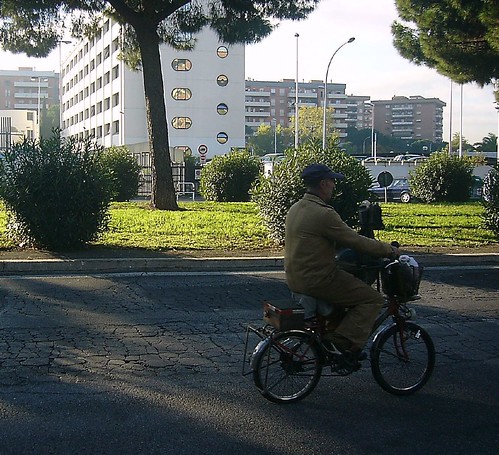
In doing a bit of research for this post, I have come to learn that I am not the only one puzzled by this most mysterious figure. I myself have only actually seen him once. He rides around on a makeshift bicycle, and when there are knives to sharpen, he flips it over and turns the pedals with his hands to run the wheel that sharpens the knives.

I found some discussions in Italian about this and came up with two photos. Many of the Italians on the forums couldn’t believe that someone had actually captured a traditional arrotino in flesh and blood:


But folks, it doesn’t stop there. There is an even more high-tech version of the arrotino. Once when I understood Italian better, I was over at a friend’s house and heard something coming over a loudspeaker from outside. The piped-through-a-megaphone voice was shouting this: “Donne! E’ arrivato l’arrotino!” Basically it was a recorded voice yelling “Women! The knife sharpener has arrived!” My friends told me it was a classic thing that they had always heard as they were growing up. They said a car with loudspeakers tied to it would slowly drive around to announce "the arrival." They could all recite the recording by heart, word for word, which had me laughing. In fact, I found a hilarious yet very informative blog post that talks about this phenomenon, (unfortunately only in Italian), in which Mr. Diego tells us that the voice says the same thing and is the same man in ALL OF ITALY. It’s a recording and none of the Italians I found online seem to know who this famous man actually is. Does he really exist?

When I first heard it, I thought this whole recording was so incredibly, well, fifties. I mean, come on—did people really go outside to have this guy sharpen their knives? Yelling: "Women!" I’d never even heard of such a thing and was immediately intrigued.

I found an mp3/Flash video file that records the voice. It’s a funny article in Italian asking: Who is the Knife Sharpener? You can listen to it here (if you don't read Italian, click on "avanti" to go through the screens first, to get to the audio file. Even if you don't speak Italian, it's worth a look.) Here’s the translation (very loosely, as I did it myself) of what he says:

Women! The knife sharpener has arrived!
He sharpens knives, scissors, little scissors, silk scissors, prosciutto knives!
Women! The knife sharpener and umbrella repairman has arrived!
We fix umbrellas! The umbrella repairman, women!
We repair gas kitchens! We have replacement parts for gas kitchens!
If you have a gas leak we fix it! If your kitchen smokes, we take the smoke out of your gas kitchen! We work right away! Immediately! The knife sharpener has arrived!


In Mr. Diego’s post, he even mentions “my” arrotino here in Trastevere, one of the last of the traditional knife sharpeners. He asks if nowadays anyone really comes out of their houses with knives and umbrellas, and notes that the “gas kitchen” mentioned on the recording no longer exists. Yet, the omnipresent recording persists. Truth be told, many butchers still utilize this service, and the one time I saw my biking arrotino in action was when he was sharpening knives for the fruit seller in front of my house. These are the things that remind me that Trastevere is probably the only true village left in this big capital city, and I hope that enough people keep lowering baskets full of knives (slowly and carefully, of course, so as to avoid any unfortunate "mishaps") to have my arrotino pedaling along for many years to come.

So, another local mystery, somewhat solved...all that was missing was some evidence that I had actually seen an arrotino in action. Well, I guess the guardian angel of bloggers decided to smile down on me, because, although I had never actually seen one of these cars driving around before, only heard it coming from who knows where...just a few days after I wrote a draft of this post to publish later, I was walking down the street and I heard his native call! I felt like I was spotting an exotic animal on an urban jungle safari. I struggled with my camera: hurry, hurry, he's coming this way! And in the end, I got it. Not very exciting, I grant you, and I'm quite convinced that the arrotino himself thought I was either out of my mind or a very confused tourist (um, the Colosseum is THAT way) but still, proof that the elusive figure known as the arrotino does still exist. And his car's not all that shabby, either. Business must be good in the umbrella-repairing field lately. It is raining today, after all.

Monday, December 04, 2006

Guest Blogger: Ale, Notaio Hopeful

Today I get a day off while my future hubby (T minus less than four months) takes over the heavy lifting of the blogging duties for me. I showed him your comments on the Offida post and your curiosity got him motivated to explain the process of becoming a notaio, or notary, to you. The other night after dinner he sat down with his laptop and hammered out the following, which remains unaltered except for a few very minor spelling corrections ... bravo Ale! And to think, this was the same guy who, when we first met, said to me, "I want you to know that I hate English." (Traces back to some traumatic experience with a mean high school teacher.) Who would've ever thought that a mere six years later, he'd be negotiating with Don Johnson's, ahem, I mean, DJ's, LA agent, when a client of his decided to make a movie? Ah, life, does it not reserve its surprises for us? Perhaps one of them will be Ale becoming a notaio.

(You must all now make the "rock on" sign, with both hands, fingers directed towards the ground, to prevent my previous sentence from jinxing his chances. This in Italian is called "making the horns" or fare le corna, and is the less-vulgar version of another choice that, if you have any contact with Italian culture, you are probably aware of. All's I'm gonna say is that the second option involves scratching a region below the belt. No, I am not kidding.)

But enough of my blabbering! Here's the Italian for you:

Actually the notaries in Italy are the inheritance of the middle age, when the people didn’t know how to read and how to write and they needed a trustworthy guy doing it for them and checking that everything was honest and legal. Nowadays the problem is that even if everyone is able to read and write, we (in Italy) still need a guy who checks the contract is honest and respectful of the law, otherwise everyone would try to rip the other off.
And this guy is the notary.
But how can you be sure this guy is trustworthy?
We have to pay him a ton of money so that he doesn’t need to be bribed to become rich. A "poor" notary makes about €10,000 a month. An average notary makes about €1 million a year. A rich notary makes around €20 million a year.
And this is the notary.
For this reason here when we need to sell or buy a house we have to go to a notary.
When we want to create a company we need to go to a notary.
When we want to take a mortgage we need to a go to a notary.
Because he’s the only one who can certify all the papers are ok and transfer the rights.
He can do that because the government gives him the “power” to do that with the public seal.
So he writes the contract and he stamps it with this seal and you buy or sell your property, take the mortgage and create your company!!!
The issue is that to check the integrity of these guys, the law says they have to be a small, closed number.
Now I think we have just 6,000 notaries in all Italy (over 70 million people!!!!!) You can understand why they became so rich!!!!!! And you can understand the reason why I’m so bored to be a lawyer and I want to become a notary!!!!!
But here there is another problem.
The procedure to become notary is the most complicated and difficult procedure in all Italy procedures (and everything in this country is more difficult than usual).
You have to take a law degree.
You have to attend a notary office for 2 years.
And you have to take the “CONCORSO”
More or less every 2 years there is the Concorso.
It consists of 3 parts.
The first one is called “preselezione.”
It means you have to memorize 10,000 multiple choice questions about the civil law.
The computer chooses 45 questions and you have to answer in the right way all 45 in 45 minutes.
If you do just 1 mistake you are OUT.
Once you pass this test (I passed it 3 times) you have the most difficult work. “LA PROVA SCRITTA”
It consists of 3 days’ work closed in an underground government room in which they give you 3 different essays to do pretending you are a notary and a university professor of law. Everyday just to dictate the question (yeah, because the Commission doesn’t give you a paper but it dictates it!!!) it takes 1 hour and a half because just the subject is 4 pages long.
You can have with you only your pen, blank paper and the civil code. And you have to explain all the legal issues the question gives you and write all the acts a notary is supposed to write, in 7 hours per day.
Usually you have to write down all the stuff straight, because the subjects they give you are really long and complicated. And each written work comes out to 20-25 pages.
So at the end of the 3 days you wrote 60-70 pages, you finished 3 pens, and you have (like me the last time) your hand bleeding!!!!!
After this you have to wait 2 years; this is the time the Commission needs to correct the work.
If you pass the “scritto” you can go to take the “orale” (oral exam) which is much easier.
But there are so few people that pass the “scritto”…….
Average to do all this stuff, without “un calcio in culo” that in Italy means when someone “helps” you, it takes 10 years.
This happened to my friend Paolo, who now is a notary in Offida.


More or less after 10 years he passed the contest.
And the funny thing was that he was so bored of all this stuff that he decided not to do the contest anymore, and so it was his last contest and it was the good one.
When you pass the contest the government gives you a list of cities you can choose.
And he chose this beautiful town of Offida where he’s the only notary.

The main piazza of Offida, where Paolo has his office.

And now he’s enjoying all the 10 years work he did.

Paolo's office, with frescoes on the ceiling.

One day I hope to do the same.

View from Paolo's office window.

Otherwise I will have to be a bored lawyer for all my life.

THIS IS ALL TRUTH (NO EXAGGERATION) AND I DID IT 3 TIMES AND I’M STILL SANE.

Monday, November 27, 2006

Five Things They Told Me About Rome

Almost 6 years ago, when I was about to embark on my first trip ever to Rome, and first trip outside of the US for that matter, suddenly it seemed like everyone was an authority on Rome. People started coming out of the woodwork with any scrap of knowledge they had about Rome and Italy, even if they’d never been there. And of course, almost none of it was positive. Have you ever noticed how this seems to happen in life? As if I wasn’t nervous enough, going on this adventurous trip alone.

Well, here are a few of the things they told me, and what I actually experienced. Maybe you’ve heard some of the same. Maybe you’ve had different experiences. I’m curious to know!

1. Watch out for Roman men.

Ha. This is a good one, especially considering I met my husband the first day I arrived in Rome. (It’s always when you’re not looking, I tell you!) This piece of advice is stupid. I don’t really know what I was supposed to “watch out” for. Plus, I’ve had Roman men tell me to watch out for Neopolitan men. Ask a Milanese which men to watch out for, who knows what they’d tell you! Even my Lonely Planet guidebook listed Roman men as one of the top 5 negative things about Rome. Here we go generalizing again.
It’s true that women here may get a bit more overt attention on the street than they are used to in their home country, for example I sometimes notice men ogling women and they aren’t so subtle about it. But I wouldn’t consider that cause for alarm—it’s certainly not all men who do this, and it could be simply considered a cultural difference. As someone once told me--living in Rome is like living on a stage: everyone plays a role and everyone is constantly being observed.
2. (could be 1a?) Watch out on the bus and subway—the men will pinch your butt.

This one was already laughable even before I’d come to Italy, but, when you have no personal experience, and other people seem to, it makes you kind of impressionable. I am happy to report that this turned out to be an old-fashioned urban legend, and after nearly 6 years of riding public transport more than I care to, I have never been harassed. That’s not to say that perverts don’t exist on the city’s public transport system. I’ve heard a few first-hand accounts since I’ve lived here of some, ahem, questionable behavior. But, in my experience those occurrences are thankfully few and far between, and I’ve never witnessed any. So I wouldn’t give this one much weight. (Are people still saying this? I got it from a ton of people before I left.)

3. It’s a crime to drink a cappuccino after a meal, or after about noon. Italians only drink them for breakfast.

In my observation this one turned out to be true, in general. I’ve never seen an Italian order a cappuccino after a meal. I have noted that waiters will offer them to tourists, which perhaps makes the tourists think it’s an Italian tradition, but it’s not. The only explanation I’ve managed to garner from Italians is that, “After you’ve eaten a big meal, why would you pour warm milk on top of it?” A more typical after-dinner tradition is a simple espresso followed by a small shot of a digestive liqueur to be sipped, like grappa or limoncello.

4. Italians don’t wear shorts.

This I got from my aunt the night before I was leaving, just as I was setting out my shorts to wear for the flight and my arrival. I immediately changed to a pair of black pants, and despite the fact that it was the middle of the summer, I was relieved once I arrived because I blended in way better. Shorts are usually seen on the beach or in the gym, at least in my experience here in Rome. Ditto for running shoes. Of course, if you’re a tourist, you need to be comfortable. I’m just saying—I haven’t really seen Italians wear shorts or gym shoes in the city.

5. You’re going to get your purse stolen.

In all my time here, knock on wood, or as they say here facciamo le corna, I’ve never had my purse, wallet, camera, or anything I was carrying stolen. But, unfortunately, I’ve worked with many students and tourists who have. The trick is just keeping an eye on your belongings, wearing bags to the front and holding them close, keeping a hand on your wallet in your front pocket, being aware of your surroundings, and not being distracted. Especially on bus 64 that goes from Termini to the Vatican! I think these simple tips have prevented me from being an easy target. The pickpockets don’t tend to waste time with people who look like they know what they’re doing—there’s just too many distracted tourists that are easier to pickpocket.

Well, these are just a few---what have your experiences been? If you’ve never been to Italy or Rome, what have you heard about it? What have people told you?

Wednesday, November 22, 2006

Cookie Swap 2006: Ugly But Good


I found the cookie swap through my bloggy buddies Abe and Hap (they're pugs, check them out!) who play the Saturday Photo Scavenger Hunt. I loved the idea, organized beautifully over at My Smoky Mountain Homeschool.

So, here goes, folks: I submit for your consideration an Italian recipe for cookies known as Brutti Ma Buoni: Ugly But Good.

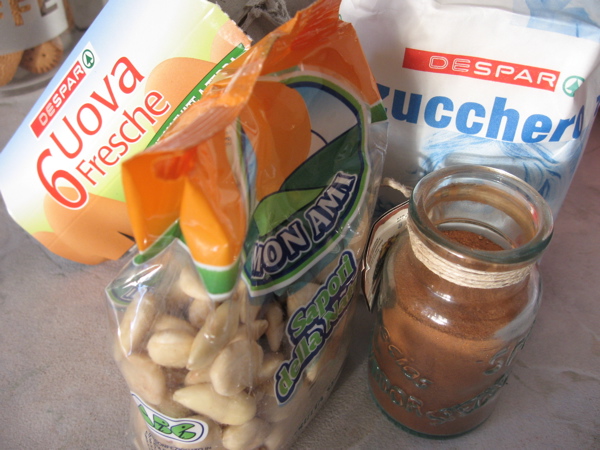
I've bought these cookies in bakeries here and the cookie swap was a perfect opportunity to try to recreate them in my own kitchen. I looked in a cookbook we have here at home (L'Enciclopedia della Cucina Italiana, no less) and found the recipe, and was surprised to see just 4 ingredients:

500 grams toasted almonds
300 grams sugar
5 egg whites
pinch of cinnamon

What? No flour? No milk? Not even water? I was intrigued.

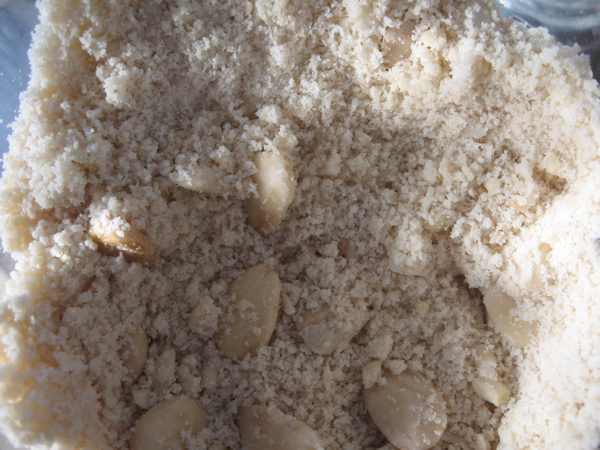
1. Ground the almonds with a little sugar. (PS I don't think the almonds I bought were toasted, and they worked just fine.) I used a blender for this operation b/c I don't have a food processor. It worked fairly well, and the almonds turned into the fluffy concoction you see below. Hmmm, almost like flour...maybe I'm starting to understand.

2. Beat the egg whites until white and fluffy. (In Italian they call it a neve, like snow.) Add the sugar, then add the egg white mixture to the almonds, and add a pinch of cinnamon. Mix.

3. Pour the mixture into a large pan and cook over a very low flame, stirring constantly, until the mixture doesn't stick to the edges of the pan. (Frankly, I'm not sure how long you're supposed to do this for. I did it for like 15 minutes and I'm still not sure if the mixture wasn't sticking, but, it came out a little thicker.)

4. Let the mixture rest for a few minutes. Scoop spoonfuls (about 2 small teaspoons each) of the batter onto a greased baking sheet, about 1 inch apart.

5. Bake in a 150°C/300°F pre-heated oven for 25-30 minutes or until golden brown. Cool on a baking rack, then serve. Makes about 2 1/2 dozen.

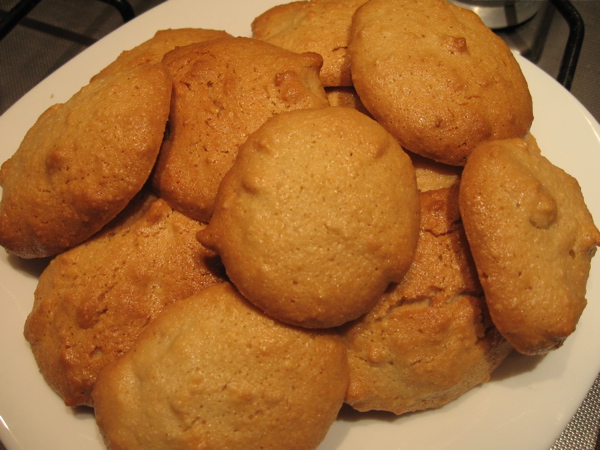
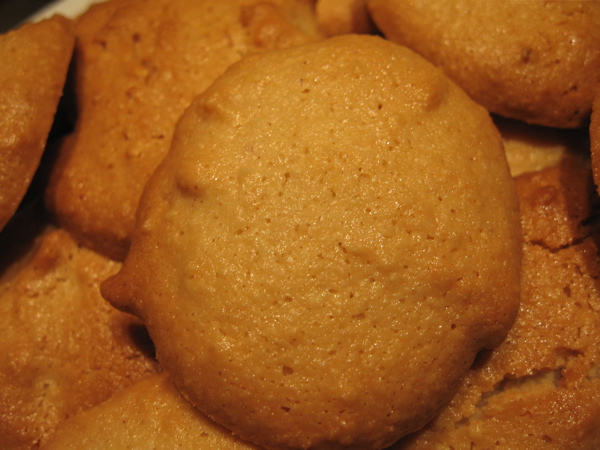
Here's the final product:


They're not that ugly, are they? I am most happy to report that these came out even better than the ones I've tasted from the bakeries. I'm convinced it's because they are fresh. I think they keep pretty well and so I suspect the ones in the bakeries aren't always necessarily from that day. I was surprised at how soft and light they were--I thought with such a heavy almond paste, they wouldn't come out like that.

As part of the cookie swap, Smoky Mountain asks us to tell the "story" behind these cookies. I've kind of told it along the way. It wasn't passed down to me from anyone. I simply really like these cookies and I'm glad the cookie swap gave me the push to try them at home. I'm really happy with the results. And I'm also happy to break the myth that the only Italian cookies that exist are what we Americans know as biscotti (which in Italian simply means "cookies"), which here in Italy are often called cantucci and not dunked in coffee but rather in a sweet wine called Vin Santo.

Speaking of wine, leave it to an Italian cookbook to recommend what wine to drink with your cookies. Mine says that Brutti Ma Buoni go good with a dry, sparkling white, and suggests Prosecco di Conegliano. (Maybe you can stop by my buddy Brendan's Roman Wine Company and pick up a bottle! Or his new, revamped blog, where you'll learn all about Italian food and wine. One of his latest posts was a trip to an olive oil factory.)

If you love candy bars like PayDay or peanut brittle, I think you'll like these cookies. Even though it's almonds, not peanuts, they have that same sweet, nutty taste.

Let me know if you make a batch. I'd be curious to hear how they turn out and what you think!

Happy Holidays!

Friday, November 10, 2006

The Vespa's Nest

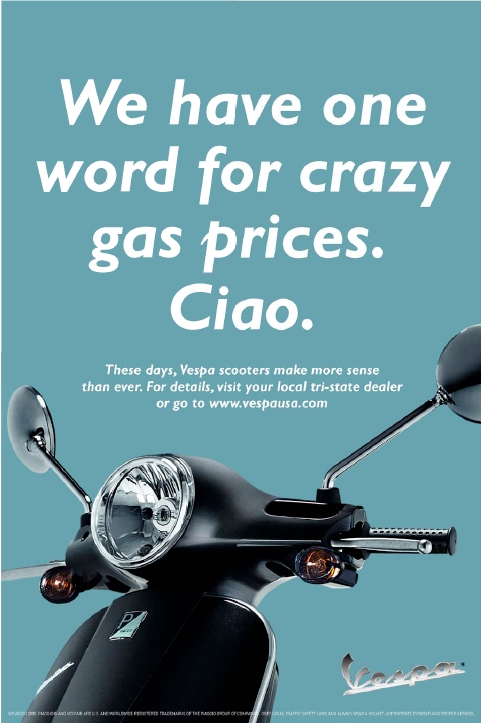
I graduated with a degree in advertising. Some people I've told this to have smiled politely and said they didn't even know it was possible to get a college degree in that. Well, yes, I am here to tell you, it is possible. You'll recognize us because we're the ones who watch the Super Bowl to get to the ads. I've been passionate about the ad world ever since I was a little kid decorating my room not with posters of Kirk Cameron (I'm an 80s kid), but with my favorite ads ripped from magazines. Although I decided to forgo the field for various reasons after working as a copywriter for a brief time, the passion hasn't ever left me. That's why, when I saw this campaign, I couldn't resist sharing it with you.

I fell in love with this campaign by The Ad Store in NYC, whose other headlines include "Relieve Gas Pains" and "Don't Be a Gas-Hole." The campaign came out in late 2005, and I find it interesting how Vespa (Italian for "wasp") is trying to sell to the US market. Do you think that this could be successful? Taking the tactic of pitching the Vespa as an alternative to high gas prices? I like the idea, but I am wondering if it's practical or not. Would your average American buy a Vespa, and is the average American commute suitable for a scooter?

Average, of course, is a term up for wide interpretation. The campaign is most likely targeted just at New Yorkers, and in fact, in this op-ed piece from the New York Times that I found on the Vespaway blog, it seems like New Yorkers are jumping on the wasp, but running up against some growing pains as they try to enter into the US city mainstream. And what age range is your typical Vespa buyer? An article from Business Week in October 2005 says that although Piaggio, Vespa's manufacturer, thought the Vespa would appeal mainly to a 20-something crowd, it turns out that over a quarter of the US market is made up by consumers age 50 and over.

Here in Rome, the Vespa really is an alternative to high gas prices and traffic jams, but it's a city scooter and can't go on the freeways. I read that they have come out with a large 250cc model, but at that point it's really not the traditional Vespa anymore, at least not in my mind, and is more of a motorcycle. The Wikipedia article has a long list of celebrity Vespa riders. I wonder if perhaps it isn't more of a trendy thing in the US, some kind of status symbol. Do you think the Vespa might ever really break past the barrier of a novelty item in the States, and go mainstream? Is it a solution to fighting high gas prices? If you don't live in the US or Italy, what's the Vespa situation like in your country?

Wednesday, November 01, 2006

Who Wants to Read a Post a Day?

Folks, I really have no clear idea why, but at the very last minute (the deadline is at 11:59 pm today), I signed up for NaBloPoMo. I mean, I can hardly keep up with reading all the blogs I like, and to think that so many of them are now going to be dishing stuff out daily--well, I suppose I figured, if you can't beat 'em, join 'em! A kind of internal peer pressure. What if I run out of things to say about Rome after posting daily in November and have to close shop? No fear! Here we go!

So, not sure if you know, but I just started renting out the tourist apartments in August. It pretty much coincides with the birth of my blog. Wouldn't have ever had enough time for a blog before that. My job working with over 100 university students, as director of their study abroad center, kept me on my toes with a small staff, a 24-hour emergency phone, and an endless supply of stories to make me the life of the party ("They did WHAT?!"). Got some real scares as well as some ha-has on the ol' E-phone, and I wasn't sad to leave it behind.

That being said, I'm still at the beginning stages of building my business. Part of it is a small DVD and book library that guests can use during their stay. Even though I don't run a B & B, I wanted to incorporate some B & B elements that I have seen in my travels and enjoyed. My only real criteria for the DVDs is that they are Italian movies with English subtitles, or movies about Italy. I just got a shipment of DVDs from Amazon for the library. Here's the list:

Life is Beautiful
Malena
Il Postino
Mediterraneo
Johnny Stecchino
Fellini's Roma
Respiro
Stealing Beauty
I'm Not Scared

My budget limits me obviously from buying everything I'd like to, but...as they say here, piano, piano (little by little).

Have you ever seen any of the movies on my list? Which one(s) are your favorite(s)? Of course, I don't have anywhere near all the ones I think are essential for a good Italian film library. What movies do you think are must-haves? A wish list never hurts!

Saturday, September 30, 2006

Unlimited Water for Your Flowers

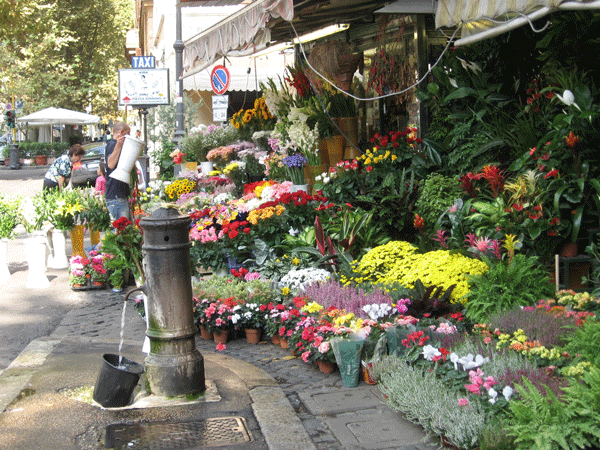
One of the things I love about Rome is the abundance of sidewalk flower stands. Here you can even see one of Rome's classic fontanelle, a constantly-running fountain of cold, fresh spring water that comes from deep underground. These little fountains are stationed throughout the city. To get a drink, you just plug the spigot with your finger, and the water starts to shoot out of a little hole on the top, making an instant drinking fountain. Rome's water is legendary and many say it's the best in all of Europe. So the answer to: "Can I drink the water?" is a definite YES, even though most Romans drink bottled water themselves, probably due to the extremely high calcium content in the tap water. In fact, even with such wonderful water, Italy has the highest per-person bottled water consumption in the entire world, at 183.6 liters per person every year.

Speaking of water, at a restaurant you will be served bottled water, and will have a choice of naturale (still) or frizzante (sparkling). You also may be asked "With gas?" or if you want acqua gassata for sparkling water. I've never seen an Italian ask for tap water, although some of the American students I used to work with would ask me how to say it. In case you're wondering, you can ask for acqua dal rubinetto. I'm not promising you won't get a strange look, but the request will be accommodated.

And of course, then there's the ice/no ice dilemma. In Italy (and most places in Europe I've been to), water and soft drinks are served without ice, but if you ask for con ghiaccio (gee-AH-cho) ice can be added. Drinks are served refrigerated so I suppose they figure ice isn't necessary. As far as free refills and doggie bags go...well, those are still concepts that haven't reached this side of the Atlantic...yet.

Monday, September 18, 2006

Italglish, or: Going Footing in Your Smoking

Something that’s always given me a few laughs and more than a little confusion is a strange hybrid vocabulary that exists here in Italy, that I know of no name for, so I will dub “Italglish” for the moment. Italglish, in my opinion, has at least two distinct categories:

1) Words that sound deceptively like English but aren’t, or do exist in English but Italians use them to mean something completely different
2) English words that have been genetically modified to resemble their Italian cousins

Today we’ll tackle #1. The fun never ends when you’re trying to figure out just what the heck a smoking (smohck-eeng) is, and why you would go footing (fu-teeng) in it. Actually you wouldn’t, unless you were a groom late to your wedding. Here’s a smoking:


That’s right folks. Who knew? Turns out Jackie Chan made a movie with Jennifer Love Hewitt called The Tuxedo, and this is its Italian cousin. You can all sleep at night now. (By the way, the caption on the bottom says something approximating: "Wear it...and there'll be trouble.")

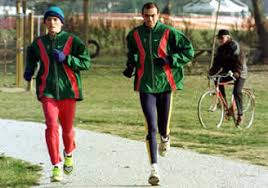
How about footing? Here you have it:


What we might call jogging. (It’s the whole “ing” ending that seems to make it all ok.) And you do use your foot, uh, feet to do it, so in some way it is close.

What about a golf? No, not the game played by Tiger Woods—more like the shirt he wears when he plays!

You can go to a beauty farm (day spa) for a snelling (weight-loss) treatment. Moo! (Associating cows with weight loss...now that's not a marketing strategy I would recommend.)

Sports are easy because they just take out “ball”: volley (voh-lay), basket...

But really, nothing beats the American TV shows imported and Italianized. Like when the Cosby show transforms mysteriously into I Robinson (Eee Roh-bean-sohn), aka The Robinson Family, apparently because “Cosby” was just too hard for Italians to pronounce. Or when that 80s classic Diff’rent Strokes becomes known as Harlem contro Manhattan (Harlem vs. Manhattan), then in later years just simply Arnold. ("Che stai dicendo, Willis?") Or when the Fresh Prince of Bel Air meets his Italian alter ego: Willy. I know you're curious...so go ahead, test out your Italian skills with Willy’s Bel Air rap in Italian.

Tuesday, September 05, 2006

My Big, Fat, Italian Wedding

Just back from a wedding down south in a little place called Paternopoli (lovingly referred to by some as 'Paperopoli', which basically translates to Donald Duck Land, the name of the town where Donald Duck lives in the Italian comic books...but I digress).

And, while we're on the topic, this morning I myself have just come back from checking out a place for my wedding, which Alessandro and I are planning for sometime early next year, exact date not chosen as of yet. (Um, €11,000 to rent two rooms with nothing else included...let me think about that for about 2 seconds...no.)

Know anything about Italian weddings? It's all about the food. Apparently, the further south you get from Rome, the more this becomes a fact.

Paternopoli is around 4 hrs. south, in the Campania region. There were about, oh, 20 or so dishes on the reception menu. Not that you get to choose. They all arrive. One after the other. We sat down to dinner at about 4 pm, and by the time we had to leave at 6:15 pm (because we had to catch a train and be back in Rome this morning), we were only on the first first course dish (there were 4, and 6 second course dishes still to come...that was after an hour-long cocktail reception with about 10 different dishes, and 3 rounds of different appetizers at the table). The general consensus at our table was that this tradition of overindulgence must be a hold over from the ancient Roman banquets...but without the couches to recline on, and thankfully without the vomitorium (apparently a misnomer) or, say, dormice (ick!).

My friend Cesare was also at this wedding. He helpfully kept a running tally of votes on the quality of each individual dish. After each round, he would announce: "Ok everyone, what do you give the last dish? 7.5 or 8?" He'd then make a note, clip his pen back to the menu, and the games would continue.

Now, in all of the 10 or so Italian weddings I've been to, rest assured that I've never spotted any of the lovely ladies displayed on the CD cover at the beginning of this post. But there are a few things besides the abundant food that seem to characterize an Italian wedding:

1) Confetti. Not the multi-colored paper you're thinking of, these are white candied almonds and I haven't been to a wedding yet that didn't hand them out to guests.

2) Lack of horrendously dressed or otherwise strategically coordinated bridesmaids. In Italy you have testimoni (witnesses), usually 2-3 for the bride and 2-3 for the groom, to witness the signatures. It doesn't necessarily have to be all women for the bride or men only for the groom, you can mix and match and that way generally choose your closest friends or family members, or someone who has special significance for you. No matched attire, although all my Italian girlfriends would love to see me have an "American-style wedding" with damigelle, as bridesmaids are known as in Italian.

3) No hokey-pokey, YMCA, or other crazy dance floor favorites, although I have witnessed a "train" a couple times at the few weddings where there was a DJ. And the wedding yesterday did actually have an accordion player (that was a first!)

All in all though, the Italian wedding isn't quite as mysterious or that different that your average American wedding. And of course, it has the benefit of all that Italian food! Viva gli sposi!